I've long been a fan of the benefits of renting -- in terms of building wealth, increasing time, and increasing quality of life by living in more ideal locations. Economist Daniel Gross seems to agree. In his recent WSJ article, Gross explains why he thinks renting will lead to the next boom in American economic efficiency (emphasis mine):
Americans are getting over the idea of owning the American dream; increasingly, they're OK with renting it. Homeownership is on the decline, and home rentership is on the rise. But the trend isn't limited to the housing market. Across the board—for goods ranging from cars to books to clothes—Americans are increasingly acclimating to the idea of giving up the stability of being an owner for the flexibility of being a renter. This may sound like a decline in living standards. But the new realities of our increasingly mobile economy make it more likely that this transition from an Ownership Society to what might be called a Rentership Society, far from being a drag, will unleash a wave of economic efficiency that could fuel the next boom...
For an increasing number of Americans, though, it simply makes more sense to rent these days. According to Moody's, by late 2011 it was cheaper to rent than to own in 72% of American metropolitan areas, up from 54% a decade ago. And the more people who do it, the more socially acceptable and desirable it becomes. The decline in the ownership rate means that about three million more households rent today than did at the height of the bubble.
It's tempting to view the rise of rentership as an economic step backward. Renters can't build up equity, and they have less control over their living standards than owners. Renting is generally seen as something you do when you've failed as a homeowner or are not yet ready to be one. But I'd argue the rise of rentership is a sign of a system adapting—albeit too slowly—to new realities.
The U.S. economy needs the dynamism that renting enables as much as—if not more than—it needs the stability that ownership engenders. In the current economy, there are vast gulfs between the employment pictures in different regions and states, from 12% unemployment in Nevada to 3% unemployment in North Dakota. But a steelworker in Buffalo, or an underemployed construction worker in Las Vegas, can't easily take his skills to where they are needed in North Dakota or Wyoming if he's underwater on his mortgage. Economists, in fact, have found that there is frequently a correlation between persistently high local unemployment rates and high levels of homeownership...
The renting is not just taking hold in housing. Gross goes on to describe how the renting business model is taking hold in markets for cars, textbooks, and fashion as well. Services like Netflix and Rhapsody allow average consumers access to video and music library that rival the largest collects in the world. Renting could have substantial impacts on economic productivity through more efficient allocation of resources, fewer unnecessary redundancy of goods in the economy, and allowing producers and consumers of these goods to take advantage of economies of scale. In my own neighborhood of Arlington, VA and around Washington, DC, the idea of renting has even come to bicycles in a brilliant way.
Given that renting is more common in urban areas, if Americans increasingly adopt a renting lifestyle, there could be additional gains in economic efficiency due to lower transportation costs, reduced energy consumption in smaller homes, and additional economies of scale that are enabled by individuals living in areas with higher population density. Harvard economist, Ed Glaeser, argues that people living in cities are healthier, wealthier, and living greener lifestyles than those in less urban environments. Additional gains from the Rentership Society?
On a personal note, being a lifelong renter has yielded enormous benefits for me. The flexibility has helped give me opportunities to travel the world, save a substantial portion of my income in my 401k in my 20s, quit my job to pursue my JD and PhD full-time, take risks that allowed me to rapidly increase my income early in my career, keep my commute down to about 10-minutes for most of my adult life, and shift careers into a job that I thoroughly love, and live in an exercise friendly community that helped me in the best shape of my life. Could I have done all of this if I owned a home? Maybe. But each of these would have been a lot more costly and entailed much greater risks.
Finally, perhaps, Americans are absorbing a piece of wisdom not from Gatsby, but from Thoreau: "And when the farmer has got his house, he may not be the richer but the poorer for it, and it be the house that has got him."
If Daniel Gross is right (and I think he is), we may be in for some significant improvement in quality of life in the near future.
Readers of this blog will know I'm a big fan of small space living. (Influenced from all my trips to Japan and traveling the world with very little.) While I'm not sure I'd want to constantly rearrange my apartment, this Barcelona flat is pretty cool.
After spending so much time and effort trying to win the SCOTTEVEST No Baggage Challenge contest to travel around the world with no luggage (and coming in as a runner-up in the contest), I've decided to go ahead and do my own No Baggage Challenge to raise money for Give Kids the World, a charity for terminally ill kids I volunteered with for 7+ years. I'm asking for friends, family, readers, and anyone else who is interested to sponsor me by donating $1 a day to Give Kids the World for every day I travel without luggage through Florida, Texas, and New York -- up to a maximum of 15 days. My trip will last from December 30th to January 13th.
If I can raise at least $100 in sponsorship, I will commit to traveling without luggage for the entire two week trip. I will also match dollar for dollar up to the first $100 pledged. I already have a friend who has committed to the first $15 (i.e., $1/day). If you'd like to sponsor me you can either send me an email with the amount you'd like to pledge or else leave your name in the comments below. Once I've finished my journey, you can donate money directly online to Give Kids the World here.
While traveling, I will document my journey with frequent photos, videos, and blog posts.
GIVE KIDS THE WORLD
Give Kids the World is a fantastic organization that helps grant the last wish of dying children to see Mickey Mouse. Give Kids the World partners with Disney, American Airlines, and many other organizations in Orlando and around the world to provide terminally ill children and their families a free six-day, all-expenses-paid vacation to Orlando. While there, the families stay at the magical Give Kids the World Village (a very special 70-acre resort in Orlando) and the 'Wish Kids' get special badges the get to wear that gives them special treatment at all the parks in Orlando (no waiting in lines, special attention from all the Disney characters, etc.). At the Village, families continue to receive special treatment with lots of activities for the children and their families -- including giving parents a badly needed night off.
I had the privilege of volunteering at Give Kids the World on a weekly basis for 7 years while I was living in Orlando. I used to dress up like a wizard and do magic tricks for the kids, dance with them at their pool party on Monday nights, and then go around with a giant rabbit (Mayor Clayton) and tuck the children into bed. To this day, I consider my involvement with Give Kids the World to be among the best things I've ever done and I miss it dearly.
If you'd like to read more about more about Give Kids the World, be sure to check out their website. You can also follow them on Facebook, Twitter, and YouTube.
Below is a video for a fundraiser in 2006 that gives a good overview of Give Kids the World Village and a virtual tour of this magical place:
You can also read more about the original No Baggage Challenge with Rolf Potts who traveled for six weeks around the world with no luggage and SCOTTEVEST, the clothing company that sponsored him.
If you're interested in sponsoring me as I travel for two weeks without any luggage, simply e-mail me with the amount you'd like to pledge to donate to Give Kids the World or write it in the comments below.
I returned home from my 5-day experiment traveling with no baggage over Thanksgiving. Overall, I'd call the trip a resounding success and would love to try some form of traveling like this again. Next time I hope for a longer trip involving air travel. I just found out late yesterday that I won a SCOTTEVEST Carry-On Coat in a contest held by Gear Diary. I can't wait to receive that jacket and see how well it works for this kind of a trip.
If you haven't done so yet, read my previous post for a video showing what I brought, thoughts about the experience, and impressions about the gear I used. Below are some final reflections with some tips and tricks for no baggage travel, lessons learned, concerns I had and whether or not they were valid, further impressions of some of my SCOTTEVEST gear, and how I would change my no baggage system.
TIPS AND TRICKS
Two Pairs of Socks and Underwear Are All You Need: This is all I used for five days and really all I'd need for a trip of any length, provided I was washing them in a sink every day. I'd bring one extra pair of each (for a total of three) -- just in case. (Ex Officio Travel Boxers and SmartWool black sock liners.) But that's all I require -- a huge saving in luggage space. I can't emphasize enough how impressed I am with the Ex Officio boxers. I find having different colors for each pair is a good way for keeping track of how often each pair has been worn.
Layering T-Shirts: The best trick I came up with this weekend is, when cool enough, to wear a t-shirt underneath a SCOTTEVEST Q-Zip with another t-shirt worn over the Q-Zip. (See photos in my last post.) This allows you to bring two t-shirts (all you really need) without having to pack any away and adds visual variety to your wardrobe. By alternating the shirts each day, you give the one worn on the outside a chance to air. If need be, you can wash one while wearing the other underneath the Q-Zip. The SCOTTEVEST Performance T-Shirts and Q-Zips match perfectly for this. I'd recommend two of each for this kind of trip with all of them being different colors from one another.
Layering Q-Zips: As I mentioned in my last post, another trick is to wear two Q-Zips -- one on top of the other. This not only adds extra warmth, but also allows you to carry two without packing either of them. Having the inner one zipped up all the way and the outer one unzipped also creates a nice look. (See photos in my last post.) When cool enough outside, there's no reason you couldn't combine this with the previous tip and wear a second t-shirt on top of both Q-Zips.
Wringing Clothes In A Towel: When washing clothes in a sink, a good idea is to wring them out in a towel afterward to remove excess water. This helps them dry much more quickly. If you know you won't have spare towels where you are staying, throwing in a medium-sized MSR PackTowl for this purpose might be worth its size and weight in your no baggage kit.
LESSONS LEARNED
Don't Dunk the Detergent: I washed one pair of socks and one pair of underwear each day in the sink using the Sea to Summit Laundry Detergent leaves. On Sunday (my final day home), I accidentally took out one too many leaves. Unfortunately, in trying to get the errant leaf back in the case, I managed to drop the whole pack in a sink full of water -- fusing the whole thing together. Lesson: keep the detergent away from the sink.
Substitutes: Following up on my detergent incident, I could have easily substituted shampoo or hand soap for detergent for washing my socks and underwear and hand soap for the shaving soap. These substitutes might not be 100% as good, but I'd be willing to bet they'd be good enough.
We Live With a Powerful Safety Net: When traveling in most parts of America (other than hiking in the backwoods), chances are you're no more than 30 minutes away from accessing anything you might need and, between services like FedEx and Amazon.com, you are probably no more than 24-48 hours away from anything you might want (outside of specialty medical or prescription needs). Your safety net gets event stronger when visiting family or friends who can help you out or loan you things in a jam. Getting convinced of this is incredibly liberating and one of the primary benefits of traveling like this. The more you realize how true this is, the less you will feel the need to bring. I'm convinced more than ever than much of what we carry with us when we travel has more to do with psychological comfort than practical necessity.
CONCERNS
Odor: One of my biggest concerns was that my clothes would begin to smell -- particularly my t-shirts and pants. (I only had one pair of pants which I wore consecutively for five days.) I'm happy to report that everything remained odor-free for the entire trip. If the t-shirts had gotten bad, I could have washed them in the sink, but I alternated between the two I had and smell never became an issue. In fact, it was so not an issue, I wore my SCOTTEVEST Performance T-Shirt again yesterday (what would have been my sixth day) on top of an Icebreaker wool shirt. I had several people compliment me on how nice it looked and no concerns whatsoever about odor. Odor ended up being a completely non-issue.
Bulk: Carrying my iPad in my SCOTTEVEST Tropical Jacket/Vest makes the jacket incredibly bulky if I pack anything (clothes, cables, etc.) in the pockets behind or in front of the iPad. The opposite side of the jacket gets bulky if I try to compensate by moving more items over to it. It's manageable to wear, but borders on looking ridiculous. I am exploring some ideas for how to pack and keep things more slim, but carrying the iPad in the "pub pocket" limits my options. I hope the Carry-On Coat I just won will do a better job of holding clothing without looking ridiculous. Bulk was a legitimate and ongoing concern.
Monolithic Wardrobe: One of the disadvantages of traveling so light is that it necessitates wearing the same clothes repeatedly for many days. Besides the odor/cleanliness issue, the other drawback is looking the same -- day in and day out. As I mentioned above and in my last post, layering the shirts in different combinations and mixing them with the jacket and windstopper vest made this a minimal concern. Also, if my future travels are like my former adventures, I tend to stay on the go a lot -- minimizing this concern. Overall, wardrobe variety was a non-issue.
ADDITIONAL IMPRESSIONS OF MY SCOTTEVEST GEAR
SCOTTEVEST Tropical Jacket/Vest: I really like this jacket and it is the core of my current travel kit. However, as I mentioned, the pocket design on it causes it to bulk up if I put my iPad in the largest pocket. The jacket would be far more versatile for this kind of travel if it had a second "pub pocket"/document pocket on the right side of the jacket in lieu of the sunglasses/camera pocket. I would prefer that arrangement much, much more. At a minimum, it seems the camera pocket could be deepened and a mini-pub pocket could be put above/behind it without any more pocket layering than on the left side of the jacket. The current design practically dictates the left side of the jacket will always be overloaded relative to the right side when used for no baggage travel. I'm concerned the Carry-On Coat may share n this design by placing both the iPad pocket and toiletries pocket layered on the same side of the jacket. Adding a second pub pocket on the right-hand side would make SeV jackets far better for carrying an iPad by allowing owners greater versatility for distributing weight more evenly across the jacket.
SCOTTEVEST Hidden Cargo Pants Pockets:These pants far exceeded my expectations for multiple days of wearing. After five days of continuous use, there were no odors whatsoever. The more I used the layered front-pockets, the more I fell in love with that design. Basically, both the right and left side have normal front pockets like you'd see on regular khakis plus an additional deep pocket which is accessed through a magnetic closure at the top. (The placement of the magnets give me minimal concern about them affecting credit cards and electronics.) This combination of two layered pockets on each side make it much easier to organize items and keep your pocket from getting cluttered, the deep pockets are a great place to carry a pocket digital camera, and the magnetic closures should keep pick-pockets at bay allowing the deep pockets to substitute for a money belt. These are quickly becoming my favorite pair of pants. (The only problem is with my recent weight loss, the pants are quickly becoming to large for me.)
CHANGES I WOULD MAKE TO MY TRAVEL SYSTEM
Pants: I love my SCOTTEVEST Hidden Cargo Pants and would certainly travel with them again. However, I think for a trip of any longer duration, a second pair of pants would be preferable -- or at least some lightweight shorts or a bathing suit -- particularly so one pair could be worn while washing and drying the second set (or simply giving the second pair a chance to air).
Leave the Computer at Home: Between my iPad and access to my parent's computer(s), I really had no need to have my laptop with me. (To be fair, the only reason I bought it on this trip was to show it to my brother.) My iPad will do ~ 75% of what I want a computer to do -- an in a pinch, my iPhone will probably do ~ 75% of what I want my iPad to do. My MacBook Pro was the only item I brought that did not fit into my jacket and I could have easily left it home. For anyone traveling without a computer, I strongly recommend using Dropbox and LogMeIn for remote access to your files and your computer respectively. There are apps for both services on the iPad, although you can use either through any standard web browser and any modern computer with Internet access.
OPEN QUESTIONS
Kindle? If I have my iPad do I really need to bring my Kindle too? I'm torn on this issue. I use both on nearly a daily basis. I am an avid reader and find the Kindle much less obtrusive, useful for reading outside, better for one-handed operation, useful for reading while walking, and with far better battery life. It's also single-purpose, limiting the potential distractions which might pull me away from reading. Given the quantity I read, the Kindle is one luxury item that probably justifies bringing it along. Having said that, the iPad works great as an eReader too, making the Kindle somewhat redundant. In a pinch, I can also use my iPhone for reading books.
iPad? I love, love, love my iPad and use it for a myriad of purposes. It's a great eBook and PDF reader, wonderful for looking up maps and information about new locales, allows me to do research, send and receive e-mails, write-up blog posts, etc. However, it's also by far the largest item in my travel kit and the one piece most responsible for the "bulking" of my jacket. It creates the most problems for packing without any luggage which begs the question of whether or not it should stay in my kit. During my last week-long trip to New York City in August, I used my iPhone nearly non-stop but my iPad less than expected. There is also something to be said for going "off grid" from time to time -- something I admittedly struggle to do. For now, I would say my iPad stays, but this experiment and recent experience has me questioning this.
No Baggage or Low Baggage? Finally, the question comes up if "no baggage" is worth the hassle of traveling over "low baggage"? Bringing a small bag -- even something as simple as a cinch sack or small shoulder bag for the iPad -- would help solve the issue of jacket bulk. It would also make it easier to set my gear down if needed, remove (or check) my jackets, etc. Candidates for good bags for low baggage travel might include items from Tom Bihn such as the Synapse, Buzz, or Western Flyer. Or even something more simple like the Tom Bihn Packing Cube Backpack or Eagle Creek Packable Daypack. I've made four recent trips -- including a week in New York City and two trips to Kansas City with only what I could fit into a North Face daypack. Using a SCOTTEVEST jacket and techniques from this No Baggage Challenge, I'm confident I could whittle this down to a significantly smaller pack. I'll give the no baggage vs. low baggage more thought after I receive my SCOTTEVEST Carry-On Coat and get a chance to play around with seeing how well it packs.
WOULD I TRAVEL LIKE THIS AGAIN?
In a heartbeat. I love the simplicity this kind of exercise forces me into. There is little room for excess gear and the size and weight of every small item matters. Whether my next trip is no baggage or low baggage, this experience has helped underscore that I can bring far less than what I am accustomed to and still have an enjoyable journey. In fact, many times bringing less means experiencing more. I'd like to experiment with no baggage on a trip where I'm more mobile for the entire journey to really get a feel for the freedom (and potential headaches) traveling this way would bring. The only way to discover this is to hit the road and give it a try. I can't wait!
I recently entered a SCOTTEVEST contest to travel around the world with no luggage. (Watch my entry video and follow-up video.) This Thanksgiving weekend, I decided to put my gear to the test and travel home for 5+ days with nothing (other than my laptop) but what I could fit into my SCOTTEVEST clothing.
WHY I'M DOING THIS
Scott Jordan, CEO of SCOTTEVEST, is holding a contest this weekend for people using SCOTTEVEST clothing to get through airport security. The winner of the contest wins a free Carry-On Coat. (In order to win, your video has to get the most views.) Since I'm not traveling by air, I decided to the next best thing I could and show how SCOTTEVEST clothing could be used to travel by car for an extended weekend. (My trip is actually more representative of how most Americans are traveling this weekend — out of 40 million traveling, only 1.6 million are doing so by air.) My hope is that Scott Jordan will consider this a good demonstration of his gear and a valid entry for this weekend's contest.
As I mentioned, I recently entered into SCOTTEVEST's No Baggage Challenge contest to travel around the world with no luggage. I thought this weekend would be a great chance to put my proposed travel kit to the test and see how it performs before taking it on an extended journey.
I made it to all 7 continents successfully without checking a bag. My last four journeys, including a week in New York City, have been with nothing other than what I could fit into a North Face daypack. I love the idea of traveling light and am challenged by Rolf Potts' and Matt Hamlin's examples of traveling without any luggage at all. I was intrigued by trying this out myself and seeing how well it works.
As long-time readers will know, I also love the idea of simplicity in general. This has been strongly influenced by my travel experiences. I thought a challenge like this would help remind me of and reinforce these ideals.
WHAT MY SCOTTEVEST TROPICAL JACKET HOLDS
(Click on image to see associated notes.)
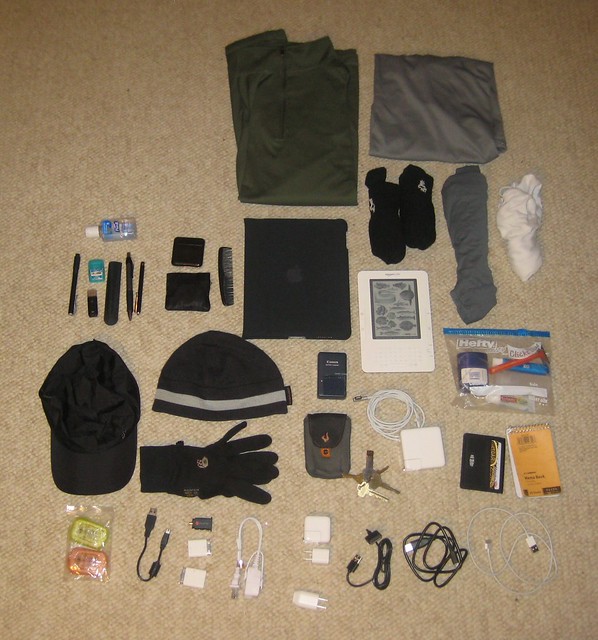
Watch the video to see where I packed everything into my clothing. Below is a photo of all the gear I was able to fit into my SCOTTEVEST Tropical Jacket and Hidden Cargo Pants. (Click on the image to see associated notes.) In addition to what is pictured below, I was also able to smuggle in an Apple TV in my jacket — a birthday present my brother and I got for my Dad.
About 30 minutes after I recorded the video above, I received an order I made last week from SCOTTEVEST. It contained two new Q-Zips and a Performance T-Shirt. (I lost 20 pounds in the last 10 weeks as a self-experiment in weight loss and get great compliments every time I wear my Q-Zip. I figured I better get a couple more.) Since these arrived before my departure, I decided to replace one of my SmartWool T-Shirts with the Performance T-Shirt and the Icebreaker wool shirt with a second Q-Zip.
Here's my final gear list (plus cables, chargers, and camera connectors):
Clothing
SCOTTEVEST Tropical Jacket/Vest
SCOTTEVEST Q-Zip * 2
SCOTTEVEST Performance T-Shirt
SmartWool T-Shirt
SCOTTEVEST Hidden Cargo Pants
Ex Officio Boxers * 2
Tilley Travel Briefs
SmartWool Socks * 3
Ecco Shoes
Icebreaker Wool Cap
EMS Waterproof Baseball Cap
Mountain Hardwear Gloves
Toiletries
Sea to Summit Shaving Soap
Sea to Summit Laundry Detergent
Deodorant
Toothpaste
Toothbrush
Razor
Hair Gel
Electronics
iPhone
iPad
Kindle
Canon SD1000 Digital Camera
MacBook Pro (I would normally leave this at home)
HOW IT'S BEEN WORKING SO FAR
I am now in Day 4 of my trip and am tremendously enjoying how this is working so far. Granted, I'm just an hour away from home and staying in a very familiar environment (Mom and Dad's), but there is no reason to think this manner of travel couldn't be extended long-term with little difficulty. Although I am currently close to home, I am not doing anything differently than if I were 1,000 or 10,000 miles away.
Unpacking: One of the coolest things about traveling with no luggage so far is how effortless it was to unpack. When I got here, I simply removed my iPad and Kindle, put my socks and underwear in a drawer, removed my toiletries, and then hung up my jacket and shirts — and I was done. No bags to contend with, no extra junk cluttering up the room, no nothing. In about 60 seconds, I was unpacked, more organized than I usually am when traveling, and my room was just as clean as it was when I arrived. I expect my re-packing to go equally quickly.
Laundry: So far, since I am stationary for a few days, I have washed my socks and underwear each morning in the sink just before getting in the shower. I'm trying out Sea to Summit laundry strips for the first time and they are working brilliantly. They consist of a set of 50 leaves that dissolve in water. I've been using 2 per day, so a pocket-sized pack should get me through close to a month of travel. My socks and underwear are dry by nighttime. I would expect them to be equally good at drying over night. Since I'm only four days out, I haven't had to wash my t-shirts yet.
GEAR IMPRESSIONS
As much as I have been inspired by Rolf Potts and Matt Hamlin, one thing I was hoping to see more of in their travelogues were details about how their SCOTTEVEST products and other travel gear worked — both pros and cons. Here are a few of my thoughts so far:
Tropical Jacket/Vest:This piece is definitely the core of my current travel kit. The jacket is of good quality, although I am a bit concerned about the longevity of the zipper for the iPad pocket. I haven't had any issues with it so far — other than that it often takes two hands to zip and unzipped — but it feels like the zipper pull could twist if I'm not careful and seems to be weakest part of the jacket. I'm also still not a huge fan of the clear-touch fabric for the iPhone pockets — they also feel like they might be a future failure point and are at risk of damage if you run them through a dryer. I also own the SCOTTEVEST Fleece 5.0 jacket and wish the Tropical Jacket also had external chest pockets like the fleece has.
Despite these three minor concerns, this is one of my favorite jackets ever. I like the fact the sleeves zip off, turning it into a light vest in warm weather. As I mention in the video, the back pocket is large enough to hold a spare t-shirt. This has far more pockets in it than any other jacket I've ever owned (other than my Fleece 5.0 jacket) — making it a great alternative to a small backpack or shoulder bag for traveling. The fact it can fold into it's back pocket is an extra-plus for days you don't need it or want to wear it, but still need to be on the go with it packed away.
One of the greatest strengths and weaknesses of the Tropical Jacket is that it is very light-weight warmth-wise — exactly as advertised. It works decently well as a water-resistant/wind-resistant shell over a warmer base layer, but won't provide too much extra warmth on it's own. This makes it usable in a whole host of conditions — IF you layer properly. I've had a chance to wear it in the rain a time or two and it does a decent job keeping light rain off, but it will soak through if you're out in the elements for too long. It dries very quickly and should keep rain off for short-periods of time or if you're in a pinch.
(If you anticipate being in a wet or windy environment, you might want to check out SCOTTEVEST's Revolution Jacket. It's water-proof, has a removable hood, and still converts into a vest. It also has chest pockets (no back pocket, however) and strikes me as a little more stylish and better general-use shell than the Tropical Jacket. I've seen the Revolution Plus at the International Spy Museum in DC and it looks very sharp, although a little too warm for typical DC weather. The Revolution jacket sounds nearly ideal for travel.)
Before heading home for the weekend, I decided to load up my Tropical Jacket to wear while walking around Arlington running some errands. It worked well enough — although carrying the iPad in one pocket caused a very large bulge if I packed anything in the pocket in front of it. While not uncomfortable to carry, I definitely felt a little puffy with all the pockets loaded up. I met two friends for lunch while "packed" — one of them said they couldn't tell I was loaded up while the other thought my jacket did look a little bulky and suggested I get a longer jacket for packing like this. Without realizing it, she was suggesting I get something like the SCOTTEVEST Carry-On Coat to help with the bulging. I agree with her that a longer jacket would probably work better for multi-day trips. (Although you'd lose the versatility of converting it into a vest and folding it away when not in use.) The other option would be to leave the iPad at home and/or try to figure out how to pack a little lighter.
Q-Zips: Next to the Tropical Jacket, my Q-Zips are by far my favorite SCOTTEVEST products that I own. As I mentioned above, I recently lost 20 pounds in the past 10 weeks as part of a self-experiment in weight loss. The Q-Zips have a fairly athletic cut and I get many compliments about how trim I look while wearing them. They dry very quickly when wet, are incredibly wrinkle resistant, and pack relatively small — making them ideal for travel. A good idea for travel is to layer two of these on top of each other — both for extra warmth and as a convenient way to carry them (like I did with the Q-Zip and wool Icebreaker shirt in my video). Layering also has the added benefit of varying the appearance of colors by unzipping the outer layer while keeping the inner layer zipped up. (See below.)
Performance T-Shirt: The Performance T-Shirt is made out of the same material as the Q-Zip and has a similar athletic cut. I've only owned it a few days but my impression is highly positive so far. My main concern about it compared to my SmartWool t-shirt is to see whether or not it has an issue retaining odors if I have to go 2-3 days of wearing it without washing. (SmartWool products are nearly impossible to stink up.). One trick I learned for giving more versatility to my wardrobe (and potentially aid in packing) is to wear the Performance T-Shirt on top of the Q-Zip, with another t-shirt underneath. (See below.) Of course, you can always wear them alone as another way to add visual variety to what you wear.
Hidden Cargo Pants:These pants have several hidden pockets with magnetic closures and could easily substitute for a money belt. The pants have an unusual drawstring inside to help tighten them — but it is not suitable as a substitute for a belt, limiting its usefulness. I have to be careful to make sure this is tucked in or else it will stick out above the waist of the pants when I first put them on. I think the drawstring could easily be removed without affecting the functionality of the pants. (Again, a minor issue.) Of all the items in this wardrobe, these pants are the most wrinkle prone. (No better or worse than "regular" khakis.)
I do like the extra-deep pockets on the pants, but they are no where near as useful as the pockets on the jacket. Still, these are sharp looking khakis and perhaps their best feature is that you can't tell there is anything special about them by looking at them. By the time I get home, I will have worn them for 4-6 days without washing. So far, so good. After four days of constant wear, I am happy to report they are still completely 100% odor free.
For longer-term travel, I would probably prefer something more quick drying and would be less concerned about the number of pockets. I would probably also prefer to bring more than one pair so I could wear one while I wash and dry the other. (Depending on the time of year and locale, shorts might suffice for my second pair.)
Ex Officio Travel Boxers: These Ex Officio Boxers are by far the best travel underwear I've ever owned. They are quick-drying, odor resistant, and (unlike my Tilley briefs) I have never experienced any chaffing while wearing them. At some point, I'd like to try a pair of SmartWool boxers, but would be very comfortable traveling the world with only two pair (maybe three) of Ex Officio Boxers.
SmartWool Socks: Actually, these are SmartWool sock liners but look like black socks — only more durable, odor resistant, and (relatively) quick drying. (My boxers actually dry faster.) These come about as close as anything to the ideal travel socks that I've found, but are not good insulators (as I recently discovered while camping in near-freezing temperatures near Harper's Ferry a couple weekends ago — I finally figured out to wear two socks on each foot). I wish they dried a bit faster, but are otherwise great socks.
Smart Wool T-Shirt: Like the socks, these t-shirts are nearly impervious to odors (something invaluable for a long-term trip with limited clothing) and dries relatively quickly. I am still trying to test out how I think this stacks up against the Performance T-Shirt. I like them both.
Mountain Hardwear Windstopper Vest: This is a thin, but surprisingly warm, fleece vest with windstopper technology which blocks wind from getting through. I have found the vest to be useful in a greater range of temperatures than a traditional fleece jacket and quite stylish as well. It also packs smaller than a full jacket and gives added variety to my wardrobe when worn over another garment. (See below.)
Sea to Summit Laundry Detergent & Shaving Cream: These two products have been one of my more recent discoveries and I am delighted to have found them. Basically they consist of small leaves (similar to Listerine breath strips) that dissolve in water -- either turning into detergent for doing laundry in a sink or else lather up into shaving cream for shaving. Each small container holds 50 leaves and so can last for quite a while. (I find one shaving cream leaf a day is sufficient and two detergent leaves are enough for washing one pair of socks and one pair of underwear in the sink.) Since these are non-liquid, you should be safe keeping them out of your TSA 3-1-1 ziplock bag and are small enough to fit into nearly any pocket or bag. I like the shaving leafs much better than shaving oil I've tried in the past or than carrying a trial-size can of shaving cream. Highly recommended!
CLOSING THOUGHTS
If you can't tell, I'm really enjoying this experience so far. Both from a practical and a more philosophical perspective. Despite having traveled all over the world without checking bags, this experiment makes me feel like I've always been an overpacker. It is experiential proof that we really do need less than we think we need.
I will follow-up with more thoughts after I get home in a few days.
Following up on my video entry for a contest to go around the world with no luggage, I decided to put my gear to the test by traveling home for 4+ days over Thanksgiving with nothing but what I could fit in my jacket. (I'm also hoping this will be considered a valid entry for SCOTTEVEST's Carry-On Coat contest this weekend. While I'm not going through airport security with this ensemble, I easily could with much less hassle than dealing with bags.)
Long-time readers of this blog will know how much I love to travel and that how travel to the developing world played a huge role in getting me interested in economics. I've journeyed to 28 countries and all 50 states so far and successfully made it to each of the 7 continents without checking any luggage (including Antarctica). A natural progression of my travel-light philosophy is traveling with no bags whatsoever -- and I just entered a contest to do exactly that. My proposal? To travel to all seven continents on one journey with zero bags.
Rolf Potts, renowned travel writer and blogger, recently proved this type of trip is possible -- traveling for six weeks to twelve countries on five continents, as part of a No Baggage Challenge. Scott Jordan, founder and CEO of travel clothing company SCOTTEVEST, was one of the sponsors of Potts' journey and has now extended this challenge to others in the form of a contest.
In applying for this contest, I propose emulating much of what Potts did with the added dimension of two extra continents involving more extreme weather conditions. If selected, I intend to share my journey on this blog including photos, videos, and regular journal entries -- using both my iPhone and iPad to document my travels. (To get an idea of what you might expect, here are just a few of my many misadventures over the years.)
Your votes are needed!
In order to make this journey, I need your help. Below are my two video entries for the No Baggage Challenge (you can see entries of other contestants here), describing my proposed itinerary and the gear I intend to bring. To be selected, I have to garner the most votes -- either on this poll on Facebook or else by sending SCOTTEVEST a direct e-mail (nobaggagechallenge@scottevest.com) indicating a vote for me. I sincerely appreciate any support you are able to give.
And if you like my entry, please help spread the word.
Start pages are a dime a dozen, but considering how many times you open a new tab every day, it's nice to have something attractive to look at. Web site Fav4.org is a minimal start page that's easy on the eyes.
The default four sites are the four you see above—Facebook, Flickr, Gmail, and Twitter—but you can customize your Fav4.org start page with a number of different popular sites (though we can think of at least one blog that, ahem, appears to be missing). Click the site settings link in the lower-right corner of the window to adjust your favorites or suggest a site you'd like added. There's not much to it beyond that. It's lightweight and attractive. My main feature wish: keyboard shortcuts for launching your favorites.
I began wondering if I was to whittle down my tech possessions to just three items, what would they be. I think we could easily live without the television/projector (we don't subscribe to cable and depend on streaming media or iTunes at this time, but probably average somewhere in the ballpark of 2 hours of viewing). I just purchased a GPS unit, but this is more of insurance for travel than a necessity. I love my vintage home audio system, but to be honest, both Emily and I listen to most of our music collection from a digital source instead of from the collection of vinyl we've held onto. So when it comes down to it, the three home tech or appliance I've deemed essential in my life are:
MacBook Pro
Canon S90 digital camera
iPod Touch
Between those three devices, I've got home audio, video, gaming, communications, online connection and various other functions covered. Two of the three also are actual necessities for my professional field, so they made the cut by default. I could probably even drop the Touch off that list, as the functions are redundant with the inclusion of a laptop. So a camera and a computer...those are the only two things I now realize are real necessities in the scope of my personal and professional life. Huh...and this whole time I thought I just had to have that panini press and 12 remote controls.
If you were to boil down your tech possessions to three essential items, which would they be?
Below are what I consider to be my tech essentials in order of priority. My shortlist would be similar:
ThinkPad X61. (I'd love to eventually replace this with a MacBook Pro.) In addition to computing, it could easily replace my DVD player for my TV.
iPhone. Quite possibly the best gadget I’ve ever owned. While I could live without an iPhone easier than I could without a computer of some sort, this is a close #2.
Canon PowerShot SD1000. (I also have a DSLR, but if I could only have one camera, I'd probably chose a pocket-sized one that I'd carry all the time. If I had my druthers, right now it would be a Canon S90.)
My second tier would include:
52-inch Samsung HDTV. I often use this as my computer monitor at home. Unlike the rest of the list, it is also something that can be used/enjoyed by more than one person at a time. Plus it looks really cool in my small studio apartment.
Amazon Kindle. An absolute joy to read on. With this in my bag, I am never without a library of books to read. It’s slim enough it takes up very little space. Great for transferring papers I am both reading and writing. (TIP: Transfer papers you write over to the Kindle and use the text-to-speech feature to have it read it back to you. Great way to get feedback on your writing.) Also being lightweight and easy to read in sunlight, the Kindle is perfect for reading while walking.
Tier three would be:
GPS. I proved to myself on my recent trip to Orlando that my iPhone works just fine (comparable to my Garmin) as a GPS using MotionX GPS Drive. However, the 99-cent program (plus $5 per month after 30-day trial) requires a data connection to operate. Also your navigation can get messed up if you receive a call while following GPS directions. Of the items on this list, this is the one I use the least. (Living eight blocks from school and two blocks from the subway, I rarely drive anymore.) However, whenever I do drive, I find it indispensible.
Netbook. My Asus 901 can fulfill 90% of my computing needs. There are times when it gets too slow that it inhibits my productivity, but for most tasks it does just fine. It gets about 5-7 hours of battery life (compared to 1 hour on my Lenovo) and is half the size of my ThinkPad. Most days, I throw this into my bag and leave my ThinkPad at home.
Finally, tier four would include:
My Digital SLR. It takes better pictures than my pocket camera, with better battery life and superior performance -- not to mention the ability to expand with new lenses, flashes, etc. My goal for this year is to bump my DSLR up a tier or two on this list.
My 24-inch computer monitor. Nice for working at my desk, but getting less use than it did before I started hooking up my laptop to the Samsung TV. Still, it’s wonderful to have – especially when I’m working on programming projects in Python, taking notes while researching, and for blogging.
If I had to, I could reduce down to the first three. Not having to, I appreciate having all nine. I love the philosophy of owning nothing not useful or beautiful. In keeping with that, I use nearly all of these (other than my GPS and cameras) on a daily basis. And the TV adds a nice aesthetic to my tiny apartment.
For people looking to lose weight or exercise more as a New Year's resolution, Philips DirectLife may help by offering a simple method for keeping track of your exercise goals. Here is David Pogue's review:
The DirectLife, from Philips ($80 until January, then $100), doesn’t try to track your sleep. It doesn’t have the wireless transfer, either; instead, every so often, you snap it magnetically into its U.S.B. docking cradle/charger connected to your Mac or PC...
[T]he DirectLife is a white, flat, one-inch square plastic doodad that you can wear on a neck cord under your clothes, carry in your pocket or slip into a belt pouch.
There are no numeric displays. If you set the DirectLife down on a flat surface, a row of little green indicators lights up to show you how close you are to your activity goal so far today — one dot, you’re a couch potato; nine dots, you’re a superjock. But that’s it.
Yet despite all that, if your goal is to lose weight or get in shape, the DirectLife is far more likely to help you succeed. First, it’s waterproof, so you can wear it swimming (or in the shower). Second, it’s crushproof... Third, the Web site and setup instructions are far more professional, complete, well-designed and classy...
But the DirectLife’s real killer feature is the personal coach that comes with it. The company employs a team of fitness and nutrition experts (20 so far) whose sole job is to look over your activity data, answer your questions and egg you on.
You get 12 weeks of coaching with the purchase price (thereafter, it’s $12.50 a month)...
I hate to admit that it took some plastic gadget to change my own habits, but I found plenty of tiny ways to move more. (My favorite: I’ve taken to parking in the farthest spot instead of the closest one. It took some explaining when I took my children to a movie, but they took it in stride.)
Other gadgets confer this same awareness, of course: you can put Nike’s $30 accelerometer in your running shoe and track the data on your iPod screen, or you can buy more expensive gadgets like the BodyBugg. Those are more elaborate, conspicuous approaches.
What’s so likeable about these new gizmos is that they’re so tiny and simple and cheap, it’s almost no effort to use them. We all know that few people actually stick to their New Year’s resolutions. But I’m betting that you’d stick with these wearable plastic bits longer than you would with a gym membership — and pay a lot less.
DirectLife is so simple, it is brilliant. No fancy data to interpret, no major changes to behavior needed to make use of it, no new interfaces you have to learn -- just e-mailing the personal trainers. (And you already use e-mail, don't you?) It has me tempted.
Reduce the cost of something and expect to see more of it. The neat innovation of DirectLife is that it reduces the cost of keeping track of physical activity so low, many people just might actually stick to it.
Read two reviews of this by Fast Company here. and here.
Perfection comes with a price. This link primarily focuses on this concept as applied to finances, but the graph below illustrates how diminishing marginal returns applies to most things in life.
To sum up the two main reasons I tend to shy away from perfectionism:
1) In my experience, the benefits typically do not outweigh the costs; and (perhaps more importantly)
Could you simplify your possessions to fit in the trunk of a car? Which ones would you take?
This is an interesting question and one I think about every time I move or travel. (For the record, I'm in the middle of a move to a new studio apartment and am out in Santa Fe for a month, living on only what I could fit into my carry-on luggage.)
If I had to fit everything in a car trunk, I'd abandon all my furniture, many of my clothes, my external computer monitor, etc. Here's a shortlist of what I would keep:
My laptop, netbook, and external hard drive(s).
My Kindle and MP3 player.
A small box of souvenirs I've picked up from my travels around the world, plus a couple of sentimental items.
My travel pack full of my favorite clothes. (Mostly what I've brought to Santa Fe plus a few additional items, such as a navy blazer.)
A box or two of my favorite books and a list of my all the books in my current library.
My Leatherman, my grandpa's tape measure, and maybe a couple other small tools.
A few choice files and documents.
My cell phone.
My camera gear.
My therma-rest and maybe my tent and a few other pieces of camping gear.
My messenger bag and Day Pack.
That's probably about it. I'm sure I may be forgetting something and would certainly miss a few things, but probably not as much as I might think. This is a fun thought exercise to think about what you most value and why.
How about you? What would you keep if you were limited to only what could fit in the trunk of your car?
If you had to fit all of your belongings in a suitcase and walk away, what would you pack?
My list would actually look much like what I described above for my college suitcase. Those items, along with books from the library and my Nintendo DS, would take care of how I spend the vast majority of my time provided that my family was with me. I’d need some basic supplies for cooking, of course - a few pots and pans and a few dishes - but, in the end, what else do I need?
If you carry that thought a little further, why not simply apply the “suitcase test” to every purchase that you make? If it’s not something that will fit in your “suitcase” - basic clothing, basic toiletries, cooking supplies, and a small number of splurge items - don’t buy it, or at least strongly consider not buying it.
This is a great thought experiment and one that I find myself both challenged and motivated by. I love the idea of having few things, but I also seem to like the idea of getting new things too. These two desires are not always at odds with each other, but they aren't always in sync either.
One of the things that always motivates me to start getting rid of stuff is traveling. I've made it to each of the continents with only carry-on luggage. There has never once been a trip where I wish I had brought more stuff, but plenty where I wish I had brought even less. The same concept seems to apply to life in general. I always feel most free when I'm able to parse down what I own. That doesn't mean I never buy new things (my friends will testify to that!), but what it does mean is that ideally every time something new comes in something old should go out. (Or better yet -- one in two out.)
One of my biggest weaknesses countering against this is books. I have a ton and they seem to flow freely into my home -- even when I'm not buying them, I seem to be getting more at conferences and seminars I go, ones my friends give me, etc. I love the idea of getting many of them in some kind of an eBook format, but as I was finishing up a paper for my Neuroeconomics class yesterday, I was reminded that there's nothing to replace being able to grab a pile of books and papers and quickly scan through and reference information you're looking for. Unfortunately, many of the eBook readers (such as the Kindle) don't tell you page numbers if you want to cite a reference in an academic paper. (Getting things in a PDF format would fix this problem, but would prohibit adjustments to font size.)
As a beginning challenge, maybe start by asking yourself what you'd keep besides furniture, clothes, and books if you only had one suitcase? Could you fit it all in? If a suitcase it too challenging, ask the same question limiting yourself to a trunk, a dresser, a closet, a car, or a room. If you really want to go to the limit with this kind of thinking, you could try taking on the 100 thing challenge.
Below is a photo of my getting ready to board my ship for Antarctica back in 2005. You can't really see much of it, but I'm wearing an old Eagle Creek travel pack that is sized to fit in an overhead bin. Between that and my shoulder bag, I had everything for the voyage including a Gore-Tex dry suit for kayaking, a bunch of Ibex wool clothing for the cold weather, my digital camera, and my laptop for downloading all of my photos onto. I had everything I needed and then some. The question I always ask myself after coming back from trips like this is why can't I live more simply like this all the time?
The shot below is of my truck loaded with half of everything I owned in the world when I moved back to Virginia from Orlando. (Mom and dad had come down with their pick-up a month earlier to get the other half.) I got rid of a most of my furniture and many (100+) books, slowly acquiring new furniture after I got up here. I still felt (and feel) like I have too much stuff. My biggest challenge is just finding the time to sort through what I have in order to parse it down even more.
Peek is a $79 handheld gadget that is a dedicated device for doing one thing and one thing only -- email. Except now it also allows unlimited text messaging and image viewing as well. Peek costs $79 and the e-mail/text service is $20 per month.
When I first read about Peek a few months ago, I wasn't overly taken with the idea, but the more I read about it and think about the more impressed I've become. If you already have some sort of smartphone, this obviously isn't for you, but this may make sense for the rest of the population. I see it particularly useful for people who are already locked into cellphone contracts who would like to get e-mail on the fly, students (and others) who don't have cell phones and/or computers at home, people who don't want the complexity of a smartphone, etc. I have a friend who doesn't have a cell phone and uses Skype to keep in touch with everyone and another who doesn't have a computer at home. Something like this would be ideal for both of them.
For the record, the Peek can do probably 2/3 of what I use my Treo for and I would find it far easier to live without cell phone connectivity (I'd just use Skype instead) than I could without text messaging and e-mail on the go. For someone looking to reign in their budget, the Peek just might be a good way to go.
I really like the simplicity of this layout and the great use of a small space. As much as I love my new 24" widescreen monitor, it basically required me to purchase a new desk from IKEA to have enough space for it and my laptop. The screen is so huge, it totally dominated my old desk. While I don't regret my choice in the slightest, the size of your desk and your space is something important to consider when purchasing a widescreen monitor.