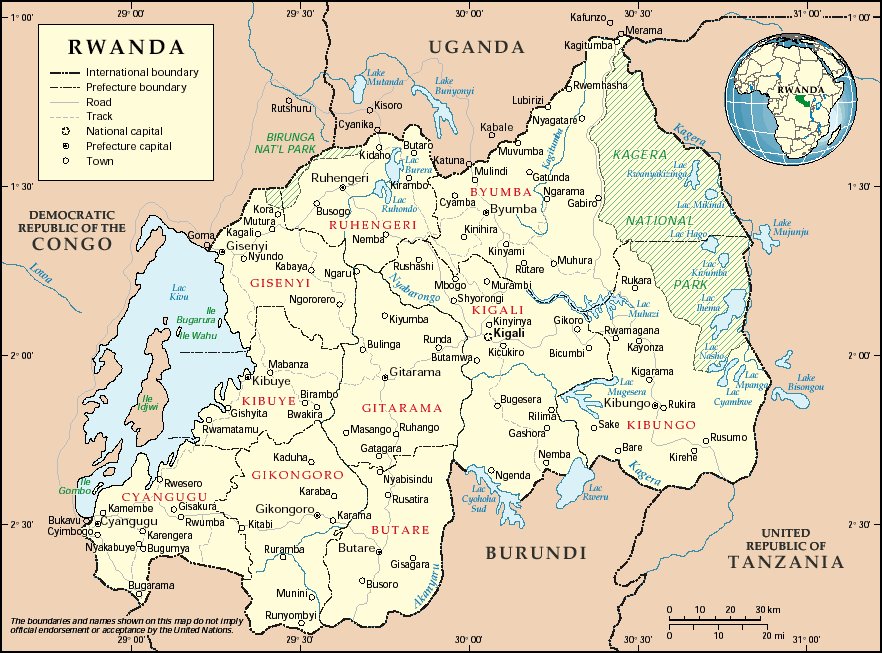
Some critics have argued that one of the main driving forces behind Rwanda's 1994 genocide was extensive conflict over land (Jared Diamond is one example, in his book Collapse). Rwanda is extremely densely populated and very poor. As families in Rwanda grew, children had less and less land to farm. Because 90% of the country was involved in agriculture (and still is) this made it exceptionally difficult for people to sustain themselves by farming. So, to put things bluntly, people might have engaged in violence during the genocide in order to get access to scarce land held by their neighbors (I take issue with this interpretation here).
The role land conflict played in the Rwandan genocide is debatable. Less debatable is the importance of property reform after conflicts. In fact, one of the most important policy reforms a post-conflict government can undertake is to try to clarify rights to land: rights to own, use, inherit, and dispose of land. In Rwanda, the government has owned most of the land for the past century (both colonial governments and post-independence governments). Now, the country is trying to move towards a policy of creating clearer, more individualized rights to land. This is a contentious, problematic process generally and will be in Rwanda also given how many people moved around, into, and out of the country between 1959 and 1994.
This week, the Rwandan government launched a program, funded by the British government, to create a database that clarifies who has rights to which land. There are so many metaphorical landmines involved in a project like this but hopefully, it will help accomplish several worthwhile goals: (a) clarify rights (b) encourage the development of a more formalized land market and (c) increase incentives for investment and entrepreneurship. On the other hand, a poorly executed project will entrench elites, limit the ability of women to use and protect land, and exacerbate conflict. Only time will tell.
Showing posts with label rwanda. Show all posts
Tuesday, August 11, 2009
Property Rights and Conflict in Rwanda
Thursday, February 12, 2009
Voting With Your Dollars: Social Enterprise
Here is Karol's first post. I look forward to reading many more.
The idea that private enterprise can promote useful social goals is in some ways new, but in other ways not at all new. Think about what any successful business does: it provides something that customers value in exchange for some other thing, normally currency, that a business values. Businesses provide what customers want/desire and customers find some satisfaction from acquiring what businesses offer. Most people would consider these good things -- increasing satisfaction on both ends of an exchange.(HT Tyler Cowen)
What's so interesting to me about social enterprise is that it provides a purely private way for customers to "vote with their dollars" to help improve lives and, hopefully, the business climate on the ground in developing (and other) nations.
For example, you buy a beautiful plateau basket (my favorite) from shop.indegoafrica.org. You could buy lots of other things but by purchasing this particular item you signal a) your good taste and b) your interest in supporting the development of private enterprise in Rwanda. By supporting these private enterprises you, in turn, directly support the Rwandan women who work in craft cooperatives. They earn an income from these transactions and use their profits to pay school fees, buy clothing, or fix their home. Some may buy a goat or a cow. But notice how different this is from traditional foreign aid: by being a customer, a consumer, you help specific, identifiable people, your money isn't lost in some bureaucratic shuffle. You give a particular set of women incentives to produce high-quality products and they learn a host of skills in the process. They gain, you gain.
Can social enterprise "solve" the problems of poverty? It can't solve all the problems (think about corrupt judges or abusive police, for example, common problems in developing countries) but it can do an awful lot of good. In case you're interested in learning more, here is a link to the Social Enterprise Initiative at Harvard's Business School (http://www.hbs.edu/socialenterprise/). You can find some research here as well as information about events they hold and courses they offer on the topic. More to follow.
Sunday, July 13, 2008
"As We Forgive"
A film produced by a friend:Could you forgive a person who murdered your family? This is the question faced by the subjects of As We Forgive, a documentary about Rosaria and Chantal—two Rwandan women coming face-to-face with the men who slaughtered their families during the 1994 genocide. The subjects of As We Forgive speak for a nation still wracked by the grief of a genocide that killed one in eight Rwandans in 1994. Overwhelmed by an enormous backlog of court cases, the government has returned over 50,000 thousand genocide perpetrators back to the very communities they helped to destroy. Without the hope of full justice, Rwanda has turned to a new solution: Reconciliation.Watch the trailer and read this write-up on it in the Washington Post, describing how it won the top documentary prize at the Student Academy Awards in Los Angeles.
But can it be done? Can survivors truly forgive the killers who destroyed their families? Can the government expect this from its people? And can the church, which failed at moral leadership during the genocide, fit into the process of reconciliation today? In As We Forgive, director Laura Waters Hinson and narrator Mia Farrow explore these topics through the lives of four neighbors once caught in opposite tides of a genocidal bloodbath, and their extraordinary journey from death to life through forgiveness.
Read my previous post on the economics of forgiveness. Also, see my other posts on Rwanda.
Saturday, July 01, 2006
The Economics of Genocide
Aplia Econ Blog has an interesting post on the economics of genocide:
This issue is particularly meaningful to me on several fronts. First, I have been researching the economics of reconciliation over the past few months, focusing particularly on reconciliation in Rwanda. In order to understand the reconciliation, it is also important to understand the genocide.
Second, I was active in attending the Save Darfur Rally and encouraged others to go. I did this out of a desire to help end the genocide in Darfur. If Kuperman is correct, this may have been counterproductive to our intended goal.
You can read more of my thoughts on Rwanda and reconiliation here, here, and here.
You can read more of my thoughts on Darfur here, here, here, and here.
They then go on to quote Kuperman:A recent op-ed by Alan J. Kuperman in the New York Times entitled "Strategic Victimhood in Sudan" advances a controversial theory: that rebel leaders in the Darfur region of Sudan share responsibility for the continued atrocities befalling their own people. Kuperman argues that the Save Darfur movement, made primarily of concerned Westerners, should stop interfering if it wants the genocide to end.
According to Kuperman, "the rebels were willing to let genocide continue against their own people rather than compromise their demand for power."
They represent his argument using game theory:
The rebels, much weaker than the government, would logically have sued for peace long ago. Because of the Save Darfur movement, however, the rebels believe that the longer they provoke genocidal retaliation, the more the West will pressure Sudan to hand them control of the region. Sadly, this message was reinforced when the rebels' initial rejection of peace last month was rewarded by American officials' extracting further concessions from Khartoum.
US INTERVENES -- Rebels Continue the GenocideAplia Econ Blog then goes on to raise great questions about the validity of this thinking. Read the whole post. It raises some great questions to think about.
US DOES NOT INTERVENE -- Rebels Stop The Genocide
This issue is particularly meaningful to me on several fronts. First, I have been researching the economics of reconciliation over the past few months, focusing particularly on reconciliation in Rwanda. In order to understand the reconciliation, it is also important to understand the genocide.
Second, I was active in attending the Save Darfur Rally and encouraged others to go. I did this out of a desire to help end the genocide in Darfur. If Kuperman is correct, this may have been counterproductive to our intended goal.
You can read more of my thoughts on Rwanda and reconiliation here, here, and here.
You can read more of my thoughts on Darfur here, here, here, and here.
Monday, April 24, 2006
Charting a Route to Restoration in Rwanda
I am currently working on research about the economics of reconciliation, with special focus on the Rwandan genocide. I just received an e-mail from Catherine Claire, one of the members of the church I attend, with a link to this excellent article by her about the Rwandan genocide and the problems, progress and necessity for reconciliation:
Here are links to some of my previous posts relating to Rwanda and/or reconciliation:
Also, please be aware of what's currently going on in Darfur. It looks like a repeat of what happened in Rwanda in 1994. Will this be another situation in which the world does nothing until after it's too late?
I visited the Dachau concentration camp just outside of Munich Germany in August, 2004. Here is a picture I took of a memorial there which reads "Never Again".

(click for larger image)
That's the same thing pledged after the Rwandan genocide. At this point, shouldn't we be saying "Yet Again"?
Read the whole thing! It is truly excellent! I had the privilege of meeting both Bishop John Rucyahana and Pastor Sam Mugisha who are mentioned in the article. Both are great men and give me strong hope and encouragement for the future of Rwanda.The machete gash across the face of Emmanuel Mahuro, a 16-year-old Rwandan native, is no longer an open wound. Today, like a jagged boundary line on a map, a scar juts down the plateau of his forehead, across the bridge of his nose, and up the hill of his right cheek.
It is impossible to look into Emmanuel’s eyes without also seeing this deep-cut ravine, a natural border-line of division etched across his face, the face of Rwanda, 12 years after the genocide.
To recall April 1994 and the onslaught of the 100 days of slaughter is to unleash memories of horror: men, women, and children hacked to death by machetes; mothers forced to dash their own babies against the walls; women raped; children burned alive. The scope of brutality exceeded the capabilities of the imagination; the rate of killing exceeded even that of the Nazis. By the time it was over, more than one million Rwandans were dead--this, in a country of just 8.5 million people.
A few years later, more than 110,000 men and women guilty of these atrocious crimes swelled Rwanda’s overcrowded prisons. Now, as tens of thousands of them are released, old wounds are re-opened. The horrifying memories of these slayings haunt everyone involved, irrespective of their role--survivor, orphan, widow, or perpetrator. One cannot chart a route to restoration in Rwanda without involving all of them and without returning to the boundary lines of genocide’s wounds. If this gash across the face of Rwanda can be stitched back together, repentance and forgiveness are the only thread strong enough to bind.
Here are links to some of my previous posts relating to Rwanda and/or reconciliation:
Also, please be aware of what's currently going on in Darfur. It looks like a repeat of what happened in Rwanda in 1994. Will this be another situation in which the world does nothing until after it's too late?
I visited the Dachau concentration camp just outside of Munich Germany in August, 2004. Here is a picture I took of a memorial there which reads "Never Again".

(click for larger image)
That's the same thing pledged after the Rwandan genocide. At this point, shouldn't we be saying "Yet Again"?
Wednesday, April 12, 2006
The Economics of Forgiveness
"And when you stand praying, if you hold anything against anyone, forgive him, so that your Father in heaven may forgive you your sins." -- Mark 11:25
I'm a bit tardy getting this post up, but this may be a good time to discuss this topic, being at a midpoint between the 12th anniversary of the start of the Rwandan genoicde and the Christian celebration of the resurrection of Christ. Both events deal with forgiveness -- one representing the need for it and the other representing the way.
Professor Pete Boettke gave a presentation on March 28th here at GMU on the “Economics of Forgiveness”. His paper, co-authored with Chris Coyne, specifically addresses the situation of nations transitioning out of oppressive regimes.
Here’s the abstract:
I also think the human capital argument is incredibly strong. A great example of this would be the Haitians killing off most of the white people as the slaves took over the nation, destroying the majority of the knowledge base of the nation along with them:
The thrust of this paper can best be summed up by this diagram:

(click for larger image)
The x-axis represents the percentage of an oppressive regime prosecuted and the y-axis shows the probability of being able to establish a new regime based on the principles of liberty. Notice that *P is the point at which yields the maximum possibility of success at setting-up a new liberal regime. This point does not coincide with the maximum number of prosecutions of old regime members, nor approach anywhere near that maximum. Prosecutions carried out beyond *P end up damaging the future welfare of the nation.
This is a powerful concept that can be broadly applied. While it is hard to think of concrete empirical evidence to “prove” this model, it seems to “fit” what I understand about the history of atrocities around the world.
Pete Boettke and Chris Coyne are to be commended for adding to our understanding about political and economic ramifications of the power of forgiveness and for giving us a conceptual model for thinking about how this can be applied in understanding real-world settings. I am currently researching the “economics of reconciliation”, particularly how it applies to African nations. Boettke’s and Coyne’s paper has greatly added to my understanding of these issues.
Download a draft of this paper here. (This is an earlier draft of the paper than the one we received. I’ll try to track down a link to a more recent copy.) Also see related papers by Tyler Cowen here and here.
I'm a bit tardy getting this post up, but this may be a good time to discuss this topic, being at a midpoint between the 12th anniversary of the start of the Rwandan genoicde and the Christian celebration of the resurrection of Christ. Both events deal with forgiveness -- one representing the need for it and the other representing the way.Professor Pete Boettke gave a presentation on March 28th here at GMU on the “Economics of Forgiveness”. His paper, co-authored with Chris Coyne, specifically addresses the situation of nations transitioning out of oppressive regimes.
Here’s the abstract:
Dr. Boettke’s thesis is that there is a point at which the pursuit of justice ends up harming, rather than helping a nation coming out of an oppressive situation. (Benefits become less than the costs.) While this might at first-glance seem counter-productive to our moral intuitions, Boettke makes a very strong case to support this. Some of highlights of this include:
The turn of the century witnessed the emergence of several new democracies wrestling with the past of oppressive state regimes that committed atrocities on their own citizens. In East and Central Europe, the former Soviet Union, Latin America, South Africa, and the Middle East, new governments and their citizens are determining precisely how to balance past and present. In the mid-20th century, Germany and Japan had to negotiate a similar political terrain. Our paper is focused on past injustices perpetrated by totalitarian regimes and using basic economic reasoning we attempt to clear a path for reconciliation and thus hope for a future of peace and prosperity.
- Demands for retribution can bankrupt the future, sometimes leading to financial claims that exceed GDP of an economy.
- A point can be reached where the cost of justice outweighs its benefits.
- Demands for retribution lead a nation into thinking in terms of the past rather than the future. Without a future orientation, the nation will never move forward.
- The debt for past deeds colors all social relations, if they are not forgiven.
- Everyone living today could find ancestors who were victims of some type of injustice.
- As temporal distance becomes greater, demands for justice must become weaker.
- Individuals operating under an oppressive regime often have to conform to the regime’s operations in order to survive and have very little ability to dissent. It is often very difficult to gauge the guilt of an individual’s actions under such conditions.
- Human capital (skills, knowledge, trust, contacts, local knowledge, etc.) is typically tied up in the former rulers of that regime. To eliminate all of those people could decimate attempts at transitioning into a free nation. (Post-war rebuilding of Japan took this into consideration. Post-war de-Baathification in Iraq did not.) Eliminating the former rulers of a regime from the future of the country also gives added incentives for those rulers to resist and disrupt transition processes.
No nation can transition into a free economy without first credibly signaling a strong commitment to the rule of law, rather than the rule of man. One of the first steps in this process is to prevent ex post facto law (retroactive laws) from being passed. Most developed nations prevent this kind of law from being passed either constitutionally or procedurally. (See the US Constitution Article I, Section 9, Clause 3.)
If one of the major problems with the totalitarian regime were intrusive and aggressive activities that violated the rights of its citizens, and the desire in the post-totalitarian moment is to establish a government constrained by the rule of law, then rectification measures that violate liberal principles of due process and rule of law must be rejected. As Jon Elster (2004:83) has put it:When they set out to deal with the lawless practices of the past, they do not want to do it in a lawless manner. Their desire to demarcate themselves from the old regime may constrain, however, the satisvaction of their desire to punish the agents of the regime. It may be impossible, for instance, to punish what appears to be obvious acts of wrongdoing without introducing retroactive legislation, thus embracing the lawless practices of the previous regimes.In short, since the totalitarian regime was not violating laws at the time of their actions, they cannot be subject ot the laws established during and after the transition. Further, retroactive laws violate the rule of law because no individual would ever be able to predict how laws would affect them or what actions should be avoided so as not to violate future retroactive laws (Hayek 1978: Chapter 14).
I also think the human capital argument is incredibly strong. A great example of this would be the Haitians killing off most of the white people as the slaves took over the nation, destroying the majority of the knowledge base of the nation along with them:
The tragic consequences of these actions haunt the nation to this day. What was done in an attempt to exact justice ended up crippling a nation for over two centuries. As Dr. Boettke said, our moral intuition often leads us awry.
The carnage that the slaves wreaked in northern settlements, such as Acul, Limbé, Flaville, and Le Normand, revealed the simmering fury of an oppressed people. The bands of slaves slaughtered every white person they encountered. As their standard, they carried a pike with the carcass of an impaled white baby. Accounts of the rebellion describe widespread torching of property, fields, factories, and anything else that belonged to, or served, slaveholders. The inferno is said to have burned almost continuously for months.
The thrust of this paper can best be summed up by this diagram:

(click for larger image)
The x-axis represents the percentage of an oppressive regime prosecuted and the y-axis shows the probability of being able to establish a new regime based on the principles of liberty. Notice that *P is the point at which yields the maximum possibility of success at setting-up a new liberal regime. This point does not coincide with the maximum number of prosecutions of old regime members, nor approach anywhere near that maximum. Prosecutions carried out beyond *P end up damaging the future welfare of the nation.
This is a powerful concept that can be broadly applied. While it is hard to think of concrete empirical evidence to “prove” this model, it seems to “fit” what I understand about the history of atrocities around the world.
Pete Boettke and Chris Coyne are to be commended for adding to our understanding about political and economic ramifications of the power of forgiveness and for giving us a conceptual model for thinking about how this can be applied in understanding real-world settings. I am currently researching the “economics of reconciliation”, particularly how it applies to African nations. Boettke’s and Coyne’s paper has greatly added to my understanding of these issues.
Download a draft of this paper here. (This is an earlier draft of the paper than the one we received. I’ll try to track down a link to a more recent copy.) Also see related papers by Tyler Cowen here and here.
Sunday, April 09, 2006
Another Rwanda?
Thursday marked the 12th anniversary of the beginning of the genocide in Rwanda. Today’s Opinion Journal has an article by Paul Rusesabagina, the hero of Hotel Rwanda. In it he discusses how today’s situation in Darfur is like Rwanda in 1994:
Mr. Rusesabagina will be speaking at George Mason this Monday at 7:30 PM in the Center for the Arts.
More about the 12th anniversary of the Rwandan genocide here and here.
I hope and pray that the world will not hesitate to act this time. Anyone have any thoughts on how we might best exert pressure to influence our politicians to take action? Any thoughts on what actions should be taken?History shows us that genocides can happen only if four important conditions are in place. There must be the cover of a war. Ethnic grievances must be manipulated and exaggerated. Ordinary citizens must be deputized by their government to become executioners. And the rest of the world must be persuaded to look away and do nothing. This last is the most shameful of all, especially so because genocide is happening again right now in the Darfur region of Sudan, and the world community has done precious little to stop the killings.
What is happening in Darfur is exactly what happened in my home country of Rwanda, which was left to choke on its own blood from April to July of 1994.
The real lesson here is that the United Nations is in need of not only reform but also a basic rethinking of its peacekeeping philosophy. World governments must agree that the extinction of a race is a crime worth stopping at any cost, and back up this sentiment with action. And the U.N. Security Council must create a tool that it has lacked for far too long--a small multinational "rapid response" force which can quickly airlift tanks, jeeps, helicopters and troops to spots where the evidence of genocide is overwhelming.
Such a force would not require endless dickering, delicacy and will-testing; it should be made up of no more than 10,000 troops and deployed only in extreme situations, because its real power is not in its gun barrels--it is in the message to genocidal regimes that the world will refuse to overlook atrocities. This would have stopped the Rwanda tragedy from happening, probably without a shot being fired. It could now stop Darfur from getting worse, with similar ease.
History offers us another lesson about genocides: The apologies, recriminations and resolutions of Never Again usually begin after the genocide is safely finished and it becomes safe once more to mourn the lack of action. That should not happen this time. The proposed extinction of an entire race should now be considered an override clause to the rule of national sovereignty. Rwanda is over and everybody mourns it comfortably. We ought not to wait until Darfur is over to start saying Never Again yet again.
Mr. Rusesabagina will be speaking at George Mason this Monday at 7:30 PM in the Center for the Arts.
More about the 12th anniversary of the Rwandan genocide here and here.
Monday, March 27, 2006
Hotel Rwanda
“We are all going to die. Dying without doing anything is a failure.” -- Paul Rusesabagina

This weekend, I watched “Hotel Rwanda”. It is an excellent movie that portray an incredibly tragic situation. The genocide in Rwanda took place starting in April of 1994 and lasted for 100 days. By the time it was over, nearly one million Rwandans had been murdered.
The movie gives the details about what happened at the Hotel Mille Collines l in Kigali, the Rwandan capital, during the genocide. The heroic actions of Paul Rusesabagina, the assistant hotel manager, saved the lives of over 1,200 Rwandans who took refuge at the hotel.
The Economist describes the genocide:
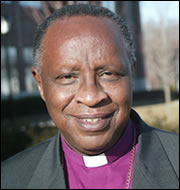
Rwanda is still healing from its wounds. I heard Rwandan Bishop John Ruchynana speak here in DC last month about the process of healing and reconciliation in Rwanda. He is working with prisoners to try to offer forgiveness. Without this, Bishop Ruchynana said Rwanda cannot go forward. The country faces tremendous tension between the Hutus and the Tutsis, many of the perpetrators of the genocide live with tremendous guilt and shame (suicides are common), and survivors are living with bitterness and anguish. Forgiveness is needed to be given and to be received in order for Rwanda to move forward towards a better future.
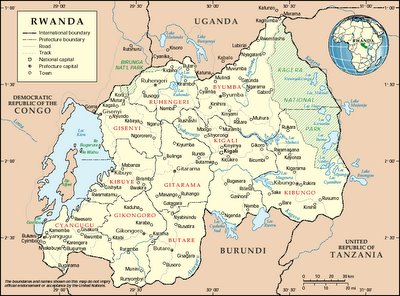
(click map for larger view)
This movie connects with me in a unique way as I am now attending an Anglican church in DC that is under the Archbishop of Rwanda, making us technically a Rwandan church. I am also working as part of the Enterprise Africa team, researching the rise of the specialty coffee industry in Rwanda and the economics of reconciliation through the Mercatus Center. This is part of my graduate responsibilities for my PhD program at George Mason. My research director, Karol Boudreax, just returned from Rwanda a few days ago.

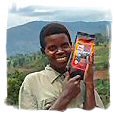
I am still in the process of learning about Rwanda – it’s history, its economy and its people. The Rwandans I have met have all been delightful and have an optimism about their country that I think is wonderful. They also know they have a lot of barriers to get through on their journey ahead. My church is helping to distribute Rwandan coffee and profits are being used to help widows and orphans of the genocide. This is being done through “The Land of a Thousand Hills Coffee". This company was started through work done by USAID and Michigan State University. This project is called Partnership for Enhancing Agriculture in Rwanda through Linkages (PEARL) program. I spoke to one of the guys working on this project over the phone last month and am very impressed with what they are doing:
I hope and pray for the Rwanda people. They have been through many tragedies that continue to affect their nation. My hope is that some of the research we are doing at Mercatus and the work the church is doing would both help to heal their land. Please pray for Rwanda’s present and its future. And next time you go to Starbucks, be sure to help out by buying some fine Rwandan coffee! As Land of a Thousand Hills Coffee says: “Drink a cup and do good!’
Additional links relating to Rwanda:
This weekend, I watched “Hotel Rwanda”. It is an excellent movie that portray an incredibly tragic situation. The genocide in Rwanda took place starting in April of 1994 and lasted for 100 days. By the time it was over, nearly one million Rwandans had been murdered.The movie gives the details about what happened at the Hotel Mille Collines l in Kigali, the Rwandan capital, during the genocide. The heroic actions of Paul Rusesabagina, the assistant hotel manager, saved the lives of over 1,200 Rwandans who took refuge at the hotel.
The Economist describes the genocide:
Nearly 10% of the population was killed in the span of 100 days.
IT WAS the purest genocide since 1945, and perhaps the single greatest act of evil since Pol Pot turned Cambodia into a killing field.
Outsiders often assume that the genocide sprang spontaneously from primeval ethnic antagonism. On the contrary, it was planned over many months—Mr Bagosora sketched out part of the programme in his appointment book in early 1993. Militias had to be organised, machetes bought and distributed, and Hutu peasants persuaded, through skilful propaganda, that all Tutsis were their enemies. The opportunity came on April 6th 1994, when Rwanda's Hutu president was assassinated. Mr Bagosora and his co-conspirators seized control of one of the world's most authoritarian states, the whole apparatus of which was then turned to mass murder.
Rwanda is still healing from its wounds. I heard Rwandan Bishop John Ruchynana speak here in DC last month about the process of healing and reconciliation in Rwanda. He is working with prisoners to try to offer forgiveness. Without this, Bishop Ruchynana said Rwanda cannot go forward. The country faces tremendous tension between the Hutus and the Tutsis, many of the perpetrators of the genocide live with tremendous guilt and shame (suicides are common), and survivors are living with bitterness and anguish. Forgiveness is needed to be given and to be received in order for Rwanda to move forward towards a better future.

(click map for larger view)
This movie connects with me in a unique way as I am now attending an Anglican church in DC that is under the Archbishop of Rwanda, making us technically a Rwandan church. I am also working as part of the Enterprise Africa team, researching the rise of the specialty coffee industry in Rwanda and the economics of reconciliation through the Mercatus Center. This is part of my graduate responsibilities for my PhD program at George Mason. My research director, Karol Boudreax, just returned from Rwanda a few days ago.
I am still in the process of learning about Rwanda – it’s history, its economy and its people. The Rwandans I have met have all been delightful and have an optimism about their country that I think is wonderful. They also know they have a lot of barriers to get through on their journey ahead. My church is helping to distribute Rwandan coffee and profits are being used to help widows and orphans of the genocide. This is being done through “The Land of a Thousand Hills Coffee". This company was started through work done by USAID and Michigan State University. This project is called Partnership for Enhancing Agriculture in Rwanda through Linkages (PEARL) program. I spoke to one of the guys working on this project over the phone last month and am very impressed with what they are doing:Currently, I am researching the economics of reconciliation. I have to write a paper for the Buchanan Seminar I am taking this semester. I am hoping to write on conflict resolution and reconciliation in Rwanda in partnership with Professor Stephen Brams of NYU. (He was one of the speakers for the seminar.) Pete Boettke is planning on presenting his paper on the economics of forgiveness this Tuesday, which I hope will tie into this topic. Tyler Cowen also has related papers here and here.The Partnership for Enhancing Agriculture in Rwanda through Linkages (PEARL) is assisting the nation of Rwanda in its efforts to rebuild from the impacts of the war and genocide of 1994. PEARL works with rural communities across Rwanda to generate income through agricultural product development and market linkages.
PEARL, a USAID-funded project led by Michigan State University, is working with grower cooperatives on the production and marketing of specialty coffee, chili peppers and cassava products, and with with Rwandan agricultural institutions to rebuild their educational and research capacities.
I hope and pray for the Rwanda people. They have been through many tragedies that continue to affect their nation. My hope is that some of the research we are doing at Mercatus and the work the church is doing would both help to heal their land. Please pray for Rwanda’s present and its future. And next time you go to Starbucks, be sure to help out by buying some fine Rwandan coffee! As Land of a Thousand Hills Coffee says: “Drink a cup and do good!’
Additional links relating to Rwanda:
- Hotel Rwanda Movie Trailer
- Hotel Rwanda Official Movie Webpage
- Rwanda: How the genocide happened
- Hate Radio Rwanda.
- Wikipedia entry on Rwandan Genocide
- BBC: Rwanda Genocide 10 Years Later
- Leave None to Tell the Story: Genocide in Rwanda
- Ghosts of Rwanda – PBS documentary on the Rwandan genocide (includes links to 40 minutes of video)
- The Triumph of Evil – PBS documentary on the Rwandan genocide
- Rwanda Information Exchange
- International Criminal Tribunal for Rwanda
- Association of Genocide Widows
- US State Department Profile of Rwanda
- Rwanda Tourism
- USAID Rwanda
- Amnesty International Profile of Rwanda
Subscribe to:
Posts (Atom)