Robin Hanson, a huge lover of science fiction and technological progress (who also happens to be an economist) writes:
On Monday I was interviewed on BBC Radio about what if any economic value we get out of NASA. I said the benefits were mostly like the pyramids - national prestige and being part of history. I was not told I would be debating a NASA fan, who said gave the tang/teflon argument that all research is good, and also said we don't want to be like the Chinese who pulled their advanced ships back just before the Europeans took over the world. There was not time to respond.
Sigh. The US government spends more on space research than on NIH and NSF combined, which most scientists consider far out of proportion to its science value. Most any ambitious tech project, like floating cities, 3DTV, or robot mules, gives similar indirect tech spinoffs per dollar spent, and surely we can find other projects with larger direct payoffs. Sure the Chinese might have colonized the Americas, but we can see now there are no similarly lush gardens accessible in space - we'll colonize Antarctica and the Earth oceans long before, as these are far less harsh environments with plenty of the sunlight and materials which are mainly what space has to offer. Yes someday we'll run out of stuff here on Earth, but that day is far off. We'll probably use kite power before solar satellites, world population is not proportional to oil production, and hopes for more than a tiny space tourism market anytime soon are pure fantasy.
I've often heard Robin Hanson called a "space cadet" or even a "replicant." So it's pretty dramatic to see him throw cold water on his fellow cadets. Technophiles, I beg of you - don't throw Robin out the airlock! :-)
Hanson started his career as a scientist and computer guy and later turned to economics. As an engineer turned economist, I completely agree with Hanson's assessment. Incidentally, most people I hear arguing the opposite perspective most vociferously have little training in either science/technology or economics.
Having said all that, I do have to admit seeing displays of space technology in action can be quite amazing (just like those pyramids). But that still doesn't make it a good economic investment.
GMU's Robin Hanson is mentioned in today's New York Times in an article on using prizes to motivate innovation (emphasis mine):
Netflix unwittingly started down the path of proving that today’s economy doesn’t have nearly enough prizes.
BACK in the 1700s, prizes were a fairly common way to reward innovation. Most famously, the British Parliament offered the £20,000 longitude prize to anyone who figured out how to pinpoint location on the open sea. Dava Sobel’s best-selling 1995 book “Longitude” told the story of the competition that ensued, and Mr. Hastings mentioned the longitude prize as a model at that meeting back in March.
Eventually, though, prizes began to be replaced by grants that awarded money upfront. Some of this was for good reason. As science became more advanced, scientists often needed to buy expensive equipment and hire a staff before having any chance of making a discovery.
But grants also became popular for a less worthy reason: they made life easier for the government bureaucrats who oversaw them and for the scientists who received them. Robin Hanson, an economist at George Mason University who has studied the history of prizes, points out that they create a lot of uncertainty — about who will receive money and when a government will have to pay it. Grants, on the other hand, allow a patron (and the scientists advising that patron) to choose who gets the money. “Bureaucracies like a steady flow of money, not uncertainty,” said Mr. Hanson, who worked as a physicist at NASA before becoming an economist. “But prizes are often more effective if what you want is scientific progress.”
These are the two essential advantages of prizes. They pay for nothing but performance, and they ensure that anyone with a good idea — not just the usual experts — can take a crack at a tough problem. Much to the horror of the leading astronomers of the day, a clockmaker ultimately claimed the longitude prize.
The good news is that the Netflix prize is one of a handful of recent high-profile prizes. One of the others is the X Prize, which was created in 1996 as a $10 million purse for the first private manned flight to the cusp of space. It was awarded just eight years later, showing once again that prize money has a way of focusing the mind.
Yesterday my friend Robin Hanson walked into my office and said "Heh, how about that football game!" My world was momentarily jarred. This may be the most normal thing Robin has ever said to me.
Fortunately, things are back to normal today. Robin is speaking at a conference on the Search for Extra Terrestrial Life. Gotta love GMU.
Come see the event of the year: Bryan Caplan and Robin Hanson will debate on Liberty vs. Efficiency, Tuesday April 14th. The debate will take place in Enterprise Hall Room 80 at 530pm. The event is open to the public so please come and bring as many guests as you'd like!
If this is anything like Caplan's debate against Larry Iannaccone on whether or not religion was rational, I expect this to be a similarly lively debate.
A student told me the other day he wanted to be a doctor, so he could help people. I thought, "What, as opposed to the rest of us who hurt people?" Contrary to the smug self-righteousness assumptions of those in "helping" professions, like child care, teaching, counseling, or emergency services, it is far from obvious that these professions are any more helpful than the rest...
Read the whole thing if you are not already convinced. I agree with Robin. Let me add that I am an equal opportunity Scrooge, I also really dislike those TIAA-CREF ads which make professors out to be saints.
I don't know if I'd have said it in quite the same way, but Hanson makes an important point. We all help one another in society through the work we do and exchanges we make in the marketplace. Christian theologians have been making this point for centuries.
Is one job really morally superior to another? More enjoyable or personally fulfilling, perhaps, but more moral? I don't think so.
Read all of Hanson's post to understand more of the point he's making.
Compared to academics, non-academics have a less idealistic view of academia. For example, compared to academic economists, non-academic economists see less social value and progress in economics research, more researcher gender influence on that research, and more journal favoritism toward those at top schools or with inside connections.
In his post, Hanson quotes this paper in the American Journal of Economics and Sociology:
62 percent were academic economists, of which 31 percent had completed their doctoral degree ... Among academic economists, nearly half were full professors; ... Only those in departments offering graduate economics degrees generally believe that [economic] research entails spillover benefits [to society]. Further, academic economists actively publishing generally agree that economic research is improving in explaining economic behavior and events; academic economists inactive as publishers generally do not.
Read more after the link.
This brings up some important questions. Do academic economists overvalue economic research? If so, how do you measure the true value of what they do? Is a lot of relatively insignificant research the price that has to be paid for the rare but powerful breakthrough? Is this true in all areas of research? How does the cost/value ratio compare of economics compared to other fields?
Here's a question to all my econ friends. When was the last major breakthrough in economics and what was it?
We often see a women complaining about a men, to that man or to other women. We less often see the gender-reversed scenario. At least that is what I see, in friends, family, movies, and music. Yes, men roll their eyes, and perhaps in generalwomen talk more about people. But women complain more, even taking these into account. Why?
The politically correct theory is that women's lives are worse, so they have more to complain about.
After all, men often ignore, disrespect, and abandon, even beat and rape, women. But slaves weren't know for being complainers, and they had the most to complain about.
Women also ignore, disrespect, abandon, and beat men. Women rarely rape men, but they do cuckold them. Men suffer more health and violence problems, and the standard evolutionary story is that men suffer a higher outcome variance, and so have more disappointments.
Clearly part of the story is that when women complain, others tend to sympathize and take their side, but when men complain, others tend to snicker and think less of them. But why are their complaints treated so differently?
One factor is that we value toughness more in men than women. Another factor is that men seem to signal their devotion to women more than vice versa. But I'm not sure why these happen, or if they are sufficient explanations.
Whatever the true story, the politically correct theory, that women complain more due to worse lives, seems both wrong and biased. Surely most people know enough men and women to see that their quality of life is not that different, at least compared to their complaint rates.
Humanity was dealt a decisive blow by a poker-playing artificial intelligence program called Polaris during the Man-Machine Poker Competition in Las Vegas. Poker champs fought the AI system to a draw, then won in the first two of four rounds (each round had Polaris playing 500 hands against two humans, whose points were averaged.) But in the final two rounds of the match, Polaris beat both human teams, two wins out of four, with one loss and one draw. IBM's Deep Blue beat chess champion Gary Kasparov in 1997.
This has gained very little news coverage, in stark contrast to the Chess case, even though far more people play poker than chess. To explain both facts, note that most people can more easily see that they lack chess than poker expertise. They can watch a poker expert fold or raise and imagine that they would have done the same, but know they have no idea why a chess expert makes his moves.
This fools people into thinking they could be a poker champion, which is why so many more people try at poker. And being less impressed by existing poker champions, people are less impressed by a computer who beats those champions. The moral: beware of underestimating computers by underestimating the difficulty of the tasks at which they excel.
I am a bit surprised this hasn't gotten more coverage, but think Hanson is correct in his explanation. Poker is similar in golf in that every now and then even a novice by chance can play a perfect hand or hit a perfect ball that convinces him that he can do it again. Chess doesn't have this stochastic dimension to it, making people more in awe of those who excel at it. What separates the poker and golf champions from normal mortals is not their ability to sometimes play a good hand or hit the golf ball with great skill, but their consistency in doing so. The ability for a computer to consistently outplay the best poker players in the world is tremendous accomplishment in the world of artificial intelligence, similar to that of Deep Blue.
The other explanation I would offer is that chess is held in higher esteem by many people in society, being thought of as relatively pure and having a certain beauty in the pure intellectual challenge of the game. In contrast, many people view poker as a bit more base -- often associated with shady activities that many people find distasteful such as gambling, smoking, drinking, etc. I think fewer people appreciate the skills and intellectual prowess required to be a star poker player than those who appreciate the skills of a chess master.
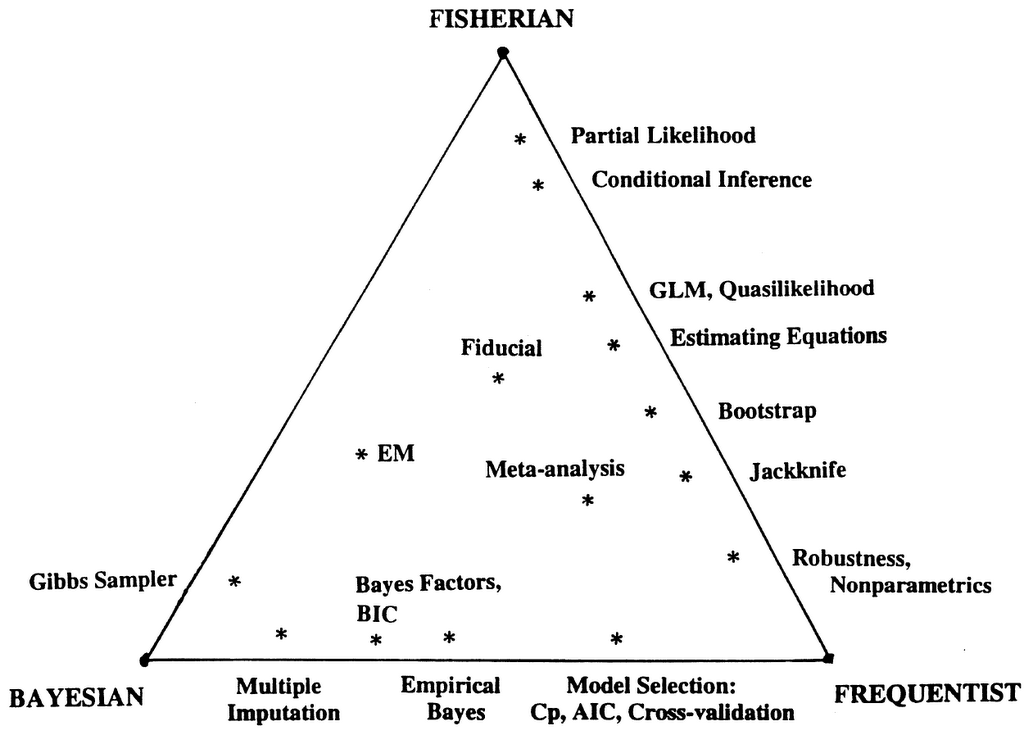
It makes a lot of sense of vague intuitions I have had about which sort of fields are related to what other fields. Economics is off on the left corner, cosmology is the top corner, and computer science hangs out between the two. And the stuff I find really boring is far away from that side.
I've ordered a printed version. I'd love to see where my papers sit in this space, and how the space has changed over the decades.
My main complaint: They arbitrarily included only "science" publications. So not only can't I see how economics relates to philosophy or literary criticism, they've foregone our best chance to define "science" in a practical way. It is famously hard to offer a coherent definition for what are "scientific" fields. But if we could see on a graph like this that "science" topics were clustered away from the rest, that would give us the best definition of "science" we are likely to get.
Just clicking around the website a bit, I see many examples of economic concepts in action such as division of labor and specialization among geographical regions and institutions. The complex web formed also provides great visual support for illustrating how knowledge is decentralized.
I am very intrigued by the insights social network analysis can give and would love see more examples of these types of graphics being generated.
"When I was a boy of fourteen, my father was so ignorant I could hardly stand to have the old man around. But when I got to be twenty-one, I was astonished at how much he had learned in seven years." -- Mark Twain
One of the essential tragedies of the human condition is that each generation must relearn so much about how to be human. Sure, life is too complicated for each generation to teach the next one about all the details we face, and many things change from generation to generation. But you might think each generation could at least make clear to the next the big timeless insights and strategies of life. You know, how to manage a career, when to leave town, how to be a good lover, friend, parent, spouse, employee, boss, etc. or what to watch out for when choosing such relations.
We do spend a lot of time teaching our young skills like how to dress and hunt and drive and write. And adults do sometimes pontificate on the big strategies of life. But such sermons are mostly ignored, and honestly they aren't often phrased very practically. So the young seem to have to relearn how to manage a career, be a good lover and friend, etc. Many learn the facts of life the hard way, and later wish they had understood such things sooner. Why?
It seems to me that a big part of the story is that a naive innocence is attractive in many ways to people forming relationships. Young people who act like they know a lot about the ways of the world are suspected, perhaps correctly, of being more self-centered and likely to defect when it is to their advantage. And the sermons of the old often seem more devoted to reaffirming their ideals than to transferring practical advice.
Dr. Hanson brings up some great questions. There seems to be two things going on at once:
The old don't seem to communicate reasons behind their advice very well, leading them to overestimate the quality of their advice to the young. ("That's just the way it is!")
The young tend to think they know much more than they do and often think they know more than the old. Both propensities lead them to underestimate the quality of the advice they receive, particularly if it's given with no rationale.
I was talking to a friend about this the other day and we both agreed we got a lot of advice from our elders and mentors that seems good in retrospect, but that was never offered to us in a well-reasoned way. We didn't understand it at the time and it made it less impactful than it might have been otherwise. We remain confused why more rationale wasn't given to us?
The older I get, the more I appreciate hanging out with older people and learning from them. I love it every time I visit or talk to my 91-year-old Aunt Ruth. The wisdom she and people of her generation have is practical, insightful, and more often than not really, really good!
Robin Hanson asks why professors aren't religious?
Last November we learned that the US public believes in God more than college professors, who believe more than professors at elite schools:
Almost a third answered "none" when asked their religion -- more than twice the percentage found in the general population. Science professors were the least religious. Accounting professors were the most religious. More than half the professors at places other than so-called "elite" universities said they absolutely believed in God. About a third of the professors at elite schools took that position. ... About 30 percent of community college professors considered intelligent design as a serious scientific alternative. Fewer than 6 percent of professors at elite universities took that position.
If all we know about a view was that professors held it more, and elite professors even more so, we would be inclined to favor that view. But other considerations can be relevant; if we knew elite professors favored increasing elite research funding, we might attribute that to self-interest bias. So should we favor elite professors' views on God, or can we identify other relevant considerations?
I'd certainly agree academics tend to be better informed regarding their own area of expertise, but how many are actually experts in religion? Why would people trust that academics are better informed than others about religion? Is it possible that since most religions are based on faith and not on reason, academics lose their comparative advantage and are therefore turned off or feel threatened by it?
There may be a selection bias and path dependency story here as well. It is true that most academics tend to lean left politically. It is also true that those on the left tend to have lower levels of religiosity than the general population. With this being so, could most of the lack of religiosity be explained by the effects of left-leaning political beliefs? (Or maybe vice-versa?) According to the Seattle Times:
The disparity is even more pronounced at the most elite schools, where, according to the study, 87 percent of faculty are liberal and 13 percent are conservative.
Does this also mean that the rest of us should favor the political views of the elite as well? That doesn't seem to follow. A more plausible story is that Democrats tend to favor the elite being in control of society which empowers those in academia, particularly those in elite institutions. It would make sense from a self-interest perspective for those academics to have a greater incentive to lean left. The more elite the institution, the greater the incentive. Because of the strong correlation between political perspectives and religious beliefs, this would probably result in fewer religious people in academia. (Interestingly, there is little effect of education level or IQ on religious belief, but a big effect from being involved in academia. The implication is that highly educated religious people tend to find jobs outside of academia.)
There seems to be a real bias in the academy against religious belief. I am hopeful that this will eventually change. As I previously wrote:
There is a common tendency in the academy to dismiss religious thinking and religious people as being somehow ignorant, backwards looking, and hindering progress. The standard assumption is that as technology, scientific knowledge, and wealth all increase, religion will decline. This is something Professor Larry Iannaccone calls the "secularization theory".
This theory is that it presumes religions will fade away (or become socially irrelevant) due to the advance of science. What is ironic about the secularization theory is that there is nothing scientific about it at all. It has no data to support it, no evidence of trends favoring it, lots of evidence contradicting it, and yet people hold on to it with what appears to be religion-like faith.
My hope is that as people begin to study religion seriously rather than condescendingly, it will bring about more respect for and insight about religion and religious people and the significant role religion may play in bringing about development and working as a stabilizing force in society. It may also go a long way towards respecting other people's "right to be wrong".
Professors Peter Boetkke and Alex Tabarrok write in today’s Slate:
Unlike his neighbors, George Washington, Thomas Jefferson, and James Madison, founding father George Mason has rarely gotten his props from historians and the public. Until recently, the same could be said of the university bearing his name. But the advancement of Mason's basketball team to the NCAA's Final Four is only the school's latest surprise win. The GMU economics department—which didn't even award Ph.D.s until 1983—has two Nobel Prize winners on its faculty. The law school ascended to the first tier several years ago, a striking achievement for a new program that 10 years ago was being run out of an old department-store building. What's remarkable is that GMU's freewheeling basketball team and its free-market academic teams owe their successes to very similar, market-beating strategies.
GMU has excelled on the court and in the classroom by daring to be different. Its basketball team and academic programs began with the (correct) assumption that they couldn't hope to compete against the top schools in their fields—say, Harvard Law School or the Duke Blue Devils—by directly imitating their methods. GMU lacks the resources and reputation to recruit McDonald's All-Americans or Alan Dershowitzes. So instead, GMU has hunted for inefficiencies in its markets. Coach Jim Larranaga follows the Moneyball model of recruitment: hunting for the undervalued players—the ones who everyone else thought were too short, too thin, or too fat—and then building them into a team. In its astonishing defeat of UConn, GMU's players were giving away 4 inches at nearly every position.
This is also the idea behind GMU's free-market-oriented economics department. The department got started with a heretical premise: The academic market is inefficient, so how can we exploit it? GMU knew it couldn't afford to be a first-class MIT and didn't want to be a second-class MIT, so successive chairs of the department, backed by entrepreneurial university presidents George Johnson and Alan Merten, looked for unexploited opportunities.
James Buchanan, GMU's first Nobel Prize winner, has never had an Ivy League position and indeed he has never taught above the Mason-Dixon Line. Gordon Tullock, a potential future Nobelist, has no degree in economics and took only one class in the subject. Vernon Smith, who moved his team from the University of Arizona (again, no Harvard) to GMU in 2001, had to fight to get people to treat experimental economics as more than a cute parlor game.
From the 1960s into the 1980s, a small university such as GMU could hire conservative and free-market thinkers of true genius for the same kinds of reasons that, in the mid-1960s, a middling school like Texas Western University could recruit some of the best basketball players in the nation, so long as they were black, and win the 1966 NCAA championship. Conservative and free-market economists were so undervalued that GMU could afford the best of them.
GMU remains an underdog in both basketball and economics. But Coach Larranaga has a plan to succeed in the long term and so do GMU's professors. Click here to read about how GMU is seeking out different new kinds of undiscovered geniuses.
The odds are still against GMU on the court and in classrooms. Neither in basketball nor economics is GMU a top-10 school. We cannot match the endowment of a Harvard or Stanford. Building with the odds stacked against you is difficult, but GMU proves it can be done. Look for undervalued assets, eschew political correctness, and take the long view. But don't try to imitate Mason. The opportunities Coach Larranaga found will dry up. A small economics department today is more likely to succeed by assembling a quality group of socialists than free-marketeers. Bring it on! We're ready to play.
Slate also offers a great profile of many of the professors and programs in the GMU Economics department:
At GMU we practice Entrepeneurial Economics and we still think there are unexploited profits and oddball geniuses to be found. You can't get much stranger or more brilliant than Robin Hanson, one of the architects of the Defense Department's short-lived "terror futures market." Betting markets are now used to forecast elections and they are starting to gain a foothold in the corporate world. Hanson wants to go further and have policies decided by contests in betting markets. (He calls it "futarchy.") He also has contracted to have his head frozen upon his "death," and has good arguments for why this makes sense at market probabilities and prices.
Larry Iannaccone's field of expertise is religion. Larry asks, Is a free market in religion good for religion? Kevin McCabe and his co-authors have the first published paper about running brain scans on people while they make economic decisions. Neuroeconomics, as it is called, is now a major trend in the profession. How many economists are as comfortable talking about Michel Foucault, James Joyce, or Cuban artist Tomas Sanchez as they are about Milton Friedman? Tyler Cowen is, and in a series of books—the latest being Good and Plenty: The Creative Successes of American Arts Funding—Cowen has challenged economists to think about art and culture—and aesthetes to think about economics. Other economists at GMU are pushing the boundaries of development economics, studying the politics of rational irrationality, and redesigning electricity markets.
The outsider status of both the GMU economics department and the basketball team contributes to their styles of play. We like to have fun, which is one reason that GMU is well-known outside of academia. Marginal Revolution, Tyler Cowen and Alex Tabarrok's daily blog, is a widely read source of economic insights. Other faculty blogs include Café Hayek, The Austrian Economists, and EconLog. In old school media, Walter Williams is a nationally syndicated columnist and well-known radio personality and Russ Roberts is the author of an economic romance novel (really!).
See my own thoughts about why I love GMU’s PhD program here and here.
All-to-all institutions — institutions that help connect everyone to everyone — are ancient and have been very important. Markets and money may have been the first. If I pay Sam $5 for X, and then Sam pays Peter $5 for Y, Peter and Sam have traded X and Y. Money has made this much easier. Democratic institutions allow everyone to govern everyone. Banks allow everyone to loan money to everyone. Books allow everyone to teach everyone. Wikipedia makes all-to-all teaching much easier. Web trials allow everyone to help everyone solve any problem where data would help. As Robin says, Wikipedia suggests that people will participate in all-to-all institutions when there is no obvious reward for doing so.
Liberals are messier than conservatives. Their rooms have more clutter, more color. Conservatives’ rooms are better organized, more brightly lit, and more conventional. Liberals have more books and their books are on a greater variety of topics.
Compared to liberals, conservatives are less tolerant of ambiguity, a trait researchers say is exemplified when George Bush says things like, "Look, my job isn't to try to nuance. My job is to tell people what I think," and "I'm the decider."
Conservatives have a greater fear of death.
Liberals are higher on openness, which includes intellectual curiosity, excitement-seeking, novelty, creativity for its own sake, and a craving for stimulation like travel, color, art, music, and literature.
Conservatives are higher on conscientiousness, which includes neatness, rule-following, duty, and orderliness.
Conservatives have a greater need to reach a decision quickly and stick to it.
When people are prompted to think about death—a state of mind psychologists call mortality salience—they actually become more conservative.
Conservatives are more likely to have been insecure as kids, whereas liberals are more likely to have been confident as kids.
I recently asked Robin Hanson, a professor at George Mason University, what he thought of web trials. Web trials are a way to learn how to solve difficult health problems (e.g., acne, obesity). By web trial I mean a web-based collection of data that compares different ways of solving a problem. People with the problem would go to a website, sign up for one of the treatments, follow the directions, and report the results in a standardized format.
I asked Robin because he has pioneered a similar improvement: Prediction markets are often far better than what they replace.
Here is a summary of what he said.
1. A selection effect is a big concern.
2. How could you get people to allow you (the website) to choose for them which treatment to do?
3. It doesn’t have to be restricted to health problems.
4. Perhaps you could get people to commit to this the way they do to Wikipedia.
Let's rate "the paper clip industry" as a 9 out of 10. Paper clips are pretty cheap and usually they work. Let's rate the better federal agencies as a 6.5 out of 10. Let's rate HUD as a 2.5 out of ten.
How will national health insurance do, keeping in mind that U.S. doctors do not wish to have their wages cut, Americans want the right to choose their doctors, and the U.S. is a huge, messy, decentralized, federalistic country with lots of cheats and massive, hard-to-eradicate inequalities at many different levels.
What contribution does management make toward producing output? If you watch Federal Express commercials, or read Dilbert, or listen to many technical workers when they talk to each other, the answer is “nothing.” Management is seen as purely an obstruction to the accomplishment of useful work.
If we take “management” as a sociological category, denoting a set of pointy-haired individuals disconnected from actual technical problem solving, then one could perhaps defend this position. But if we think of “management” as a collection of activities and practices, those practices seem essential, and many people, from computer programmers to chemists to special effects wizards, engage in them. But just how does management increase output?
The open-source, wiki model does not, apparently, work well for scientific publishing. Nature had placed a selection of submitted manuscripts online and invited feedback from researchers around the world, promising to take the feedback into consideration as part of the formal review process. But the scientific community showed little interest. Few authors were willing to participate in the experiement, and the online papers didn’t get much feedback.
Only two decades ago the poor nations provided only 14 percent of wealthy nations' manufactured imports. Today they provide 40 percent and by 2030 they are projected to provide over 65 percent.
As it was over the last 25 years it is the poor who will benefit the most. "The number of people living on less than $1 a day [in constant dollars] could be cut in half, from 1.1 billion now to 550 million in 2030." And the number living on less than $2 per day will decline by an estimated 800 million.
This will happen in spite of a growing world population, though growth levels will be much slower than today. The population growth rate, which was around 1.7 percent in the 1980s will decline to 1 percent by 2015 and to 0.7 percent in 2030.
I donated stem cells (bone marrow) a year ago to a woman who had leukemia. I just went into the National Institute of Health of Health (NIH) yesterday for a one year check-up and to sign some consent forms to release my contact info to the recipient. Apparently she is interested in making contact with me. The last I heard, she was “alive and well”. It’s exciting to think about being able to communicate with her and to find out who she is and how she is doing. Please pray for her continued health.
As we discussed recently, courting men seem too optimistic about their chances, while women seem too pessimistic about male intentions. Some explain these as due to high male benefit from mating success, and high female cost of poor mating.
Men willing to bother women even though those men didn't honestly think they had much of a chance would seem rude, selfish, and desperate. Women willing to reject almost all men while admitting those men had mostly good intentions and would provide enjoyable company would seem arrogant and selfish. Our biased beliefs help us retain our image as concerned about the interests of others, and not too desperate or arrogant, while actually being very eager (men) and picky (women).
For there is no medium between the two things: the earth must either be worthless in our estimation, or keep us enslaved by an intemperate love of it.
Here is one reason why there is "evil" in the world:
Whatever be the kind of tribulation with which we are afflicted, we should always consider the end of it to be, that we may be trained to despise the present, and thereby stimulated to aspire to the future life. For since God well knows how strongly we are inclined by nature to a slavish love of this world, in order to prevent us from clinging too strongly to it, he employs the fittest reason for calling us back, and shaking off our lethargy.
Adam Smith and David Hume were influenced by Calvin:
If we see a funeral, or walk among graves, as the image of death is then present to the eye, I admit we philosophise admirably on the vanity of life. We do not indeed always do so, for those things often have no effect upon us at all. But, at the best, our philosophy is momentary. It vanishes as soon as we turn our back, and leaves not the vestige of remembrance behind; in short, it passes away, just like the applause of a theatre at some pleasant spectacle. Forgetful not only of death, but also of mortality itself, as if no rumour of it had ever reached us, we indulge in supine security as expecting a terrestrial immortality.
It is odd to call someone so famous an "underrated thinker" but indeed Calvin is. You'll find the whole text of the Institutes of Christian Religion here; it makes for good browsing.
Jaber Elbaneh is one of the world's most-wanted terrorism suspects. In 2003, the U.S. government indicted him, posted a $5 million reward for his capture and distributed posters bearing photos of him around the globe. None of it worked. Elbaneh remains at large, as wanted as ever. ...
Since 1984, the program has handed out $77 million to more than 50 tipsters, according to the State Department. ... In 2004, Rep. Mark Steven Kirk (R-Ill.) visited Pakistan to assess why Rewards for Justice had generated so little information regarding al-Qaeda's leadership. He discovered that the U.S. Embassy in Islamabad had effectively shut down the program. There was no radio or television advertising. ...
In 2004, Congress passed a law authorizing the State Department to post rewards as high as $50 million apiece -- a provision with bin Laden in mind. Last fall, Rep. Dan Boren (D-Okla.) went further, introducing a bill that would raise the cap to $500 million. The State Department has declined to boost the reward for bin Laden, arguing that more money was unlikely to do any good and would only add to his notoriety.
Let's see, billions spent via ordinary means, and millions offered in bounties, and it is the bounties they blame for Al-Qaeda's notoriety and failing to catch leaders? The billions are spent and gone, while the millions in bounties we only lose when they actually work. How then is this data suggesting we should prefer ordinary means to bounties?
Today, many academics say the current US presidential election is of enormous importance, and wonder how they can help. And yet most everything I see academics doing on this election is overtly partisan - folks act as if it were obvious who is the best candidate, and just wonder how best to help that candidate.
But If this election is really more important that the typical topic covered by an academic review article, why not write election review articles to advise academics like me who are honestly uncertain how to vote? An election review article would apply typical academic standards to review what we know about the actual consequences of choosing each candidate.
For example, in this election the two candidates come from two established political parties. So a review article could summarize published analyses attempting to discern how national outcomes relate to the party holding office. Better yet, it could summarize the implications of published multivariate analyses, relating national outcomes to many candidate features. Of special interest might be candidate policy positions; one could summarize how candidate policy positions have related historically to actual chosen policies. For particular policy positions of these particular candidates, one could point to and summarize other academic review articles on the consequences of those particular policies.
Sure some will accuse election review articles of being covertly partisan. But given all the other academic review articles out there, why does no one even try this? I was hoping disinterest in presidential decision markets came from inertia and novelty-aversion, but are even academics just aren't interested in neutral evaluations?
Some good questions. Unfortunately, academics aren't the only ones who behave in such a biased way. People who aren't explicity and stronly partisan seem to be more the exception than the rule. I guess that's why there's not much of a market for this kind of research? Everyone's already made up their mind and have made themselves immune to any contrary evidence.
 Robin Hanson, a huge lover of science fiction and technological progress (who also happens to be an economist) writes:















 .


