GMU Professor Gordon Tullock is currently trading 12 to 1.
(HT Greg Mankiw)
Saturday, October 13, 2007


Things Are Getting Better All The Time
Tyler Cowen on progress:
If absolute standards of living are rising, and credit constraints are being relaxed, economic failure often means no cable TV rather than starvation.
Happy Birthday to "Glasses Off"
 Angela's blog just turned two years old yesterday. Happy birthday, Angela! I look forward to the next two years!
Read her inaugural post here.
Today, I'm A Police Officer
 I'm off to school to be a witness in a mock trial at school. I'm a police officer who doesn't like his ex-wife. I found marijuana at her apartment when I went to visit my daughter. I admit I could have planted I there, but deny having done so...
Should be fun!
Update: I was the defendant in the trial and my lawyers won the case!Spinning Woman
The Right Brain vs Left Brain test ... do you see the dancer turning clockwise or anti-clockwise?
![[spinning_woman.gif]](https://blogger.googleusercontent.com/img/b/R29vZ2xl/AVvXsEg8jihKKqCZcgGwcaqQrLnIxVVAKjUtGjKX0pLnXyhQpA7_Yug4kuKtfL4HxoRrQhaH4QGI1d1TJO49YS7442qHhe7l3oTr9reoeIvn77ZdBgvKcSzi4PzloH5vlz0gyzAcQdka/s1600/spinning_woman.gif)
(HT Marginal Revolution)
If clockwise, then you use more of the right side of the brain and vice versa.Like Megan McArdle, she keeps switching direction for me. What does that say about me?
Most of us would see the dancer turning anti-clockwise though you can try to focus and change the direction; see if you can do it.
LEFT BRAIN FUNCTIONS
uses logic
detail oriented
facts rule
words and language
present and past
math and science
can comprehend
knowing
acknowledges
order/pattern perception
knows object name
reality based
forms strategies
practical
safeRIGHT BRAIN FUNCTIONS
uses feeling
"big picture" oriented
imagination rules
symbols and images
present and future
philosophy & religion
can "get it" (i.e. meaning)
believes
appreciates
spatial perception
knows object function
fantasy based
presents possibilities
impetuous
risk taking
(HT Marginal Revolution)
Friday, October 12, 2007
Al Gore Wins Nobel Prize

Today, it was announced that Al Gore won the Nobel Peace Prize for his work on climate change. This certainly has many in the blogosphere in a buzz of dismay, noting:
Al Gore’s got an Oscar, an Emmy, and as of today a Nobel Peace Prize. And the “Draft Gore” movement thinks they’d all look good on his desk in the Oval Office.Björn Lomborg writes:
On the other hand, Greg Mankiw is happy to see a member of the Pigou Club win.This year's Nobel peace prize justly rewards the thousands of scientists of the United Nations climate change panel (the IPCC). These scientists are engaged in excellent, painstaking work that establishes exactly what the world should expect from climate change.
The other award winner, former US vice-president Al Gore, has spent much more time telling us what to fear. While the IPCC's estimates and conclusions are grounded in careful study, Gore doesn't seem to be similarly restrained.
Here are the other winners of Nobels so far this year:
- Physics: Albert Fert and Peter Grünberg for their discovery of Giant Magnetoresistance.
- Chemistry: Gerhard Erti for his study on chemical processes on solid surfaces.
- Medicine: Mario Capecchi, Martin Evans, and Oliver Smithies for their work on gene modification in mice using embryonic stem cells.
- Literature: Doris Lessing for her writing about the female experience.
A Visit From A Friend
I just got done having breakfast with my friend, Marek, who is in town for a conference this weekend. Marek was my classmate here at GMU for the last two years and recently transferred to the University of Michigan.

Last night, Professor Iannaccone organized a dinner for Marek with staff from the Center the Economic Study of Religion (CESR). It was my first time seeing several friends since my move to Arlington.
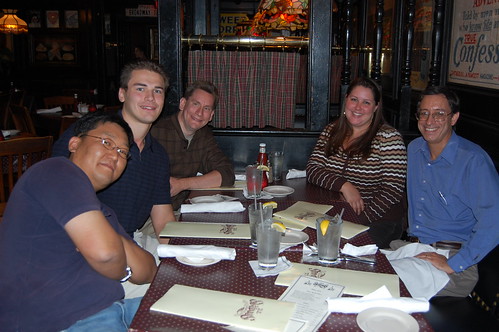
It was great seeing Marek again and see he is doing well. I was also pleased to hear he finally tried Cottage Inn Pizza in Ann Arbor on Wednesday night, one of my two favorite pizza places in the US. (The other is Pepper's Pizza in Chapel Hill, NC.)
See my previous Marek posts here, here, and here.
Last night, Professor Iannaccone organized a dinner for Marek with staff from the Center the Economic Study of Religion (CESR). It was my first time seeing several friends since my move to Arlington.
It was great seeing Marek again and see he is doing well. I was also pleased to hear he finally tried Cottage Inn Pizza in Ann Arbor on Wednesday night, one of my two favorite pizza places in the US. (The other is Pepper's Pizza in Chapel Hill, NC.)
See my previous Marek posts here, here, and here.
Molly Decker Playing In Adams Morgan Tonight
My friend Molly Decker is playing in Adams Morgan tonight:
Who: Molly Decker w/ Julia Arnold (Rene Moffatt opening)
When: Friday, October 12, 2007
Time: 7:00 dinner; 8:00 concert begins
Cost: $15
Where: The Potter’s House - 1658 Columbia Road NW, Adams Morgan, 20009
Benefits Capitol Hill Pregnancy Center and Columbia Road Health Services

Is Academia Serious About Diversity?
Greg Mankiw commenting on this article by Larry Summers:
Right-wingers challenge the left-wingers in a way that often makes them look bad. Helping the "disenfranchised" makes them look (and feel) good. Unfortunately, the incentives to make academia more politically (and intellectually) diverse just aren't there.
See Thomas Sowell's The Vision of Anointed for more on this.
P.S. -- More thoughts from Megan McArdle:
If right-wingers are underrepresented in universities relative to the population and discriminated against by the left-wing majority, as Larry suggests, should there be affirmative action for right-leaning academics? It seems that, on principle, those on the left (who favor affirmative action to promote diversity and correct past injustice) should endorse such a university policy, and those on the right (who more often oppose affirmative action) would be against.My guess is that those in academia are primarily concerned about diversity when it makes them look as though they are beneficently helping the poor and downtrodden "voiceless" classes. Since right-wingers don't fit this mold too well, I expect the left-wing majority won't be too keen on letting them in.
Right-wingers challenge the left-wingers in a way that often makes them look bad. Helping the "disenfranchised" makes them look (and feel) good. Unfortunately, the incentives to make academia more politically (and intellectually) diverse just aren't there.
See Thomas Sowell's The Vision of Anointed for more on this.
P.S. -- More thoughts from Megan McArdle:
Don't get me wrong: I don't think there's any sort of conspiracy against conservatives in the academy. I think, rather, that a combination of more subtle factors erects a wall that it's harder for conservatives to climb over. Unless they are really, really brilliant, academics, like everyone else, need personal connections to help them up the academic ladder, from recommendations to mentors to advisors. Those personal connections are always much easier to make with people you agree with. Nor would I discount the possibility that, just as women's work can be subtly dismissed because we know women aren't as bright as men, academics who think that conservatives are stupid would factor that into their assessment of someone's intelligence--and then factor that assessment into their assessment of someone's work. And of course, one's ideas are to some extent socially constructed; simply by virtue of the arguments and information we hear, even if there is no social pressure to conform, being surrounded by a political culture will tend to drag our ideas in their direction.
Thursday, October 11, 2007
Talking To My Computer: Discovering Vista's Voice Recognition
 Last week, I called GEICO to pay my insurance bill and never had to talk to a person. The voice recognition software on their automated system worked flawlessly. It allowed me to select choices, enter my credit card number, and confirm a transaction with 100% accuracy. Needless to say, I was impressed!
Yesterday, I just discovered Vista has some awesome voice recognition software built-in:
Voice recognition software has been around for a long time, but it’s only in the last few years that it has become accurate enough and simple enough to use with any regularity. It has also been rather expensive, with “basic” versions running around $80-100 and “premium” versions running to several hundred dollars – prompting many buyers to ask what was missing from the lower-priced versions.Follow the link to find out how to set it-up and get started.
If you have Windows Vista, though, you might be surprised to find that voice recognition is built in – and that it’s pretty good. While it takes some getting used to, with a little practice you’ll soon be able to use speech recognition to create and edit documents as well as to control most of the functions of your computer.
While Vista's voice recognition is not quite as good as GEICO's, it is far closer than I would have ever expected. I can control many of my computer's functions and dictate into my word processor with ~ 90% accuracy. I am surprised and tickled by how well it works..
Today, I added another capability to my tablet PC, downloading PDF Annotator. More on this soon.
Wednesday, October 10, 2007
Are You Brainy Enough to Be Religious?
 Looking for the "God Spot" in the brain:
Using functional magnetic resonance imaging (fMRI), Beauregard seeks to pinpoint the brain areas that are active while the nuns recall the most powerful religious epiphany of their lives, a time they experienced a profound connection with the divine. The question: Is there a God spot in the brain?
Persinger thus argues that religious experience and belief in God are merely the results of electrical anomalies in the human brain.
Would Persinger say the same thing about all experiences of pleasure and pain? By this reasoning, can't love, hate, perception, and contemplation of one's navel all be boiled down to electrical impulses in the brain? Also, since most people hold some level of belief in God and have religious experiences, wouldn't the lack of them be the anomaly?
[Persinger] opines that the religious bents of even the most exalted figures—for instance, Saint Paul, Moses, Muhammad and Buddha—stem from such neural quirks. The popular notion that such experiences are good, argues Persinger in his book Neuropsychological Bases of God Beliefs (Praeger Publishers, 1987), is an outgrowth of psychological conditioning in which religious rituals are paired with enjoyable experiences. Praying before a meal, for example, links prayer with the pleasures of eating. God, he claims, is nothing more mystical than that.
I'd like to see the scientific evidence he has to back up that claim.
[N]o matter what neural correlates scientists may find, the results cannot prove or disprove the existence of God. Although atheists might argue that finding spirituality in the brain implies that religion is nothing more than divine delusion, the nuns were thrilled by their brain scans for precisely the opposite reason: they seemed to provide confirmation of God’s interactions with them. After all, finding a cerebral source for spiritual experiences could serve equally well to identify the medium through which God reaches out to humanity. Thus, the nuns’ forays into the tubular brain scanner did not undermine their faith. On the contrary, the science gave them an even greater reason to believe.The problem with this line of research is that it ultimately proves nothing about religion one way or another. Just because there is cerebral activity that manifests itself during religious experience doesn't say anything about the authenticity of those experiences. Trying to say they disprove them is like saying my brain activity when I hear my mother's voice proves she doesn't not exist either.
It would be far more surprising to discover no brain activity for the experiences we feel. Persinger commits many logical fallacies in the conclusions he reaches. The nuns on the other hand are far more rational in their thinking.
Your Appendix: Maybe Not So Useless After All?
 Fascinating!
Some scientists think they have figured out the real job of the troublesome and seemingly useless appendix: It produces and protects good germs for your gut.
The function of the appendix seems related to the massive amount of bacteria populating the human digestive system, according to the study in the Journal of Theoretical Biology. There are more bacteria than human cells in the typical body. Most of it is good and helps digest food.
But sometimes the flora of bacteria in the intestines die or are purged. Diseases such as cholera or amoebic dysentery would clear the gut of useful bacteria. The appendix’s job is to reboot the digestive system in that case.That use is not needed in a modern industrialized society, Parker said. If a person’s gut flora dies, they can usually repopulate it easily with germs they pick up from other people, he said. But before dense populations in modern times and during epidemics of cholera that affected a whole region, it wasn’t as easy to grow back that bacteria and the appendix came in handy.
In less developed countries, where the appendix may be still useful, the rate of appendicitis is lower than in the U.S., other studies have shown, Parker said.

Interesting Study on the Ideology of Professors
David Bernstein:
The Inside Higher Ed. story on the study is here.
A few interesting tidbits:
(1) There is a much higher percentage of conservatives teaching at (relatively low-paying, low prestige) community colleges than elsewhere. So much for the oft-heard theory that conservatives are so scarce at elite schools because they are selfish, ambitious, money-grubbers who lack the inclination to give up the "good life" to pursue the "life of the mind."
(2) Contrary to the stereotype of the conservative business school professor, professors of business voted 2-1 for John Kerry in '04.
(3) Among social science professors (which I assume includes economics, a relatively, but not absolutely, conservative field), Ralph Nader and "Other" combined received as high a percentage of the votes as George Bush in '04.
(4) Professors are almost evenly divided on affirmative action preferences. This is consistent with my experience; supporters are a lot louder than opponents, and there are a lot of quiet opponents out there.
(5) The youngest cohort of professors is significantly more moderate than their middle-aged colleagues, but the percentage of conservatives has stayed steady (and very low).
Does It Pay To Work for Biglaw?

Yes, but it costs too:
The median salary spread for a 1st year associate at a 2 -25 lawyer firm versus a 500+ firm is $77,000. When the reference group is a 51-100 lawyer law firm versus 500+, the differential is still a substantial $55,000 per year. Cumulatively, for all eight years of the associate track, the spread amounts to $631,000 for 2-25 vs. 500+ lawyer firms and $524,000 for 51-100 vs. 500+.(HT Above the Law)
In other words, the bimodal distribution discussed in an earlier post appears to hold fairly steady during the first several years of a young associate's career. In fact, most 8th year associates at firms smaller than 250 lawyers are making less than a 1st year associate at a 500+ lawyer firm.
Obviously, the propensity toward long hours is much greater at larger law firms, with 46.8% working at least 60 hours per week. Indeed, only 12.9% of the associates in 200+ law firms are working less than 50 hours per week.
But the bottom-line is this: 60 hours is a long workweek. For many people, eights years of this pace may not be worth the $631,000 (2-25 lawyer shop) or $524,000 (50-100 lawyer firm) pay differential. After all, these years are the prime of many lawyers' lives. Solving this work-life balance issue is the holy grail for this up-and-coming generation of young lawyers.
It is worth noting that many lawyers in smaller firms end up earning a comfortable living (e.g., in my recent ISBA survey, a median partner in a 2-5 lawyer firm in Indiana makes $112,500 per year and works approximately 49 hours per week; the 75th percentile earns $162,500 per year; the 90th, $225,000).
For many young lawyers (but not all), patience and careful planning may be the best route to a practice setting that provides financial rewards, interesting work, and sustainable work/family balance. I encourage my students to keep their eyes open and take charge of their careers, starting now, while in law school.
10 Most Brilliant Inventions of 2007

The top 10 inventions for 2007:
R&D Magazine has sponsored the "Oscars of Inventions" for 45 years. These research and design awards are coveted by government as well as private industry inventors. The 100 winners selected by R&D Magazine for 2007 are stunning innovations - resourceful, effective, inspiring. A significant portion of the 2007 awards are homeland security/military innovations; others are environmental, health, and there's even innovations for kids, like a must-have-Holiday-toy robot!Follow the link for details on all 10 inventions. Here's one of my favorites:
Read the rest. They are all very cool.Some of the 2007 awards have gone to inventions that seem just short of miraculous and the Electro Needle Biomedical Sensor Array comes close. This is a small patch device with electro-chemically treated probes. When the patch is applied to the skin, it has the ability to ascertain chemical readings present in a patient's blood without having to withdraw any blood. Thus, readings such as "carbohydrates, electrolytes, lipids, enzymes, toxins, proteins, viruses, and bacteria can be detected in a patient's blood or interstitial cellular fluid." No more searching for "good" veins? You mean no more vials and vials and vials taken? One great step for medicine; 15 great steps for the sick folks in the emergency room. Developed by the Sandia National Laboratories.

(HT Presurfer)
China's Christians Finding Strength In Their Faith

A few days ago, I posted a story about the kidnapping and torture of Christian lawyer Li Heping in Beijing. Mr. Li is now in hiding with his family in fear for his life.
What wasn't initially told in Li Heping's story is the role his Christian faith has played in this ordeal. Here is a Newsweek article about Mr. Li's faith and the persecution of Christians in China:
[Mr. Li] began going to church regularly and started taking on riskier, politically sensitive cases. Recently, the 35-year-old lawyer defended another attorney who was detained for helping clients sue provincial authorities for an illegal land seizure. The historic case, one of the largest in Chinese history, puts the country's legal system itself on trial, according to Li. "I still don't have a complete understanding of Christianity," he says. "But my road is different now than it was before.Read the whole thing.
Growing numbers of progressive lawyers, journalists, environmentalists and other civic activists in China are converting to Christianity, finding support for their causes as well as personal strength in the teachings of Jesus.
China is experiencing a religious—and, in particular, Christian—boom. Scholars and clergy estimate that there are at least 45 million Christians in the country now, most of whom practice in illegal churches rather than in the state-sanctioned Catholic and Protestant organizations.
… the new Christian activism is a potential headache for the government. The party has long been wary of Christianity because of its ties to the West and its potential as an organizing force that the authorities cannot control. Already, churches have helped reform-minded people meet, recruit supporters and work together. Recently, Christian activists rallied to support a well-known lawyer, Chen Guang-cheng, whom authorities roughed up and detained. Chen (who is not a Christian) ran into trouble after he tried to organize a lawsuit on behalf of peasants who claimed their local authorities had forced them to have abortions or undergo sterilization to enforce the one-child policy.
Thanks in part to the Christian activists and other supporters, his case has become a worldwide cause. "Christianity is a challenge to the Communist Party because more people are turning to it and it presents alternative viewpoints," says Liu Xiaobo, a prominent free-speech advocate who is not a Christian. "This fact, along with pressure from the West on the Communist government, will help the cause of freedom in China."
Here is more on the social revolution Christianity is making in China and China's steps to sweep Christians out of the country.
See these BBC articles on Christian persecution in China:
- China's Christians suffer for their faith
- Three Chinese Christians jailed
- Chinese Christian leader jailed
- Chinese Christians win re-trial
International Religious Freedom News (10/2-10/9)

The Becket Fund for Religious Liberty:
- Azerbaijan: Court Fails to Overturn Pastor's Prison Sentence (Oct. 3)
- Iraq: Extremists Beat, Murder "un-Islamic" Women (Oct. 4)
- Uzbekistan: Protestants Detained, Threatened by Police (Oct. 4)
- India: Chhattisgarh's Anti-Conversion Law Reviewed by Attorney General (Oct. 6)
- Nigeria: Playwright's Shari'a Satire Banned (Oct. 7)
- Burmese Junta Shuts Buddhist Seminaries, Orders Novices to Return Home (Oct. 8)
- China: Missing Protestants Re-Appear in Labor Camps (Oct. 8)
Features:
The Patriarch of the Catholic Coptic Church on why Egypt's legal system is difficult for Christians, courtesy of the Catholic Information Service for Africa.
An inside look at Nigeria's Shari'a courts, from the BBCInternational Religious Freedom Archive
If you would like to sign up to have these weekly newsletters delivered straight to your e-mail inbox, click here.
Tuesday, October 09, 2007
10 Incredible Things To Do Before You Die

Here's the list and the closest thing I've done to each. (Of course, I didn't tell mom about most of these until after the fact.) Some I've come much closer to than others:
- Go Skydiving - I jumped off the tallest building in the southern hemisphere -- TWICE! (That's a photo of me above.)
- Dock with the International Space Station - I attended Space Camp in Huntsville, Alabama in 1995. For several months afterwards, I was a volunteer SCUBA diver at the Space and Rocket Center, doing public demonstrations for what it is like being weightlessness in space.
- Edge of Space Supersonic Jet Ride - Does riding Mission: SPACE at EPCOT without getting sick count?
- Take A Ride on a Russian Mig-Figther Jet - I've taken two private pilot's lessons and actually flown the plane for a bit. I also did several spins in a Cessna with my flight instructor friend. Unfortunately, nothing supersonic.
- Dive to the Titanic On-Board a Submarine - The closest I've come in riding the submarine tour on Catalina Island.
- Climb the Great Pyramid of Egypt - I once saw a great Egyptian exhibit at a museum in Berlin. I also ate at a restaurant inside the Mexican pyramid at Disney. No climbing, just eating.
- Visit the Great Wall of China - I've been to Japan, India, and South Korea. I haven't made it to China yet, but I'm zeroing in on it. I also once saw the Berlin Wall -- another famous barrier previously owned by communists.
- Covert Ops - One of my friends astutely noted that shortly after I left for Japan on one of my trips in 2001, China released the Navy Pilots they were holding. I'm afraid I can't say any more than this...
- Diving With Sharks - I saw nurse sharks while SCUBA diving at the Great Barrier Reef in Australia. (I also found Nemo while I was there.)
- Take an African Safari - In 2002, I rode on a bus through Etosha National Park in Namibia. During this visit, our bus got charged by an angry elephant.

One incredible experience I've had that was not on the list was kayaking with whales in Antarctica. Even among all 10 items on the list above, the exhilaration of this experience would be a tough one to beat.
 Some other fun adventures I've had include:
- White-water rafting over a 20-foot waterfall in New Zealand.
- Cliff jumping in Namibia, near the Angola border.
- Swimming in the Amazon River with Indian kids in Brazil. We stayed for a week on a river boat at the bank of an Indian village.
- Hiking deep in the jungles of Panama.
- Riding on the back of an ox cart in India.
- Body boarding down sand dunes in New Zealand.
- Climbing the Harbour Bridge in Sydney.
- Cave exploring in Waitomo, including abseiling straight down into a 300-foot cavern.
As I've written before, it is possible to have some incredible experiences on the cheap. The main point is not to follow someone else's list, but to go out and make some fun of your own.
And speaking of fun, if I ever have the chance, this is a journey I would love to take.
(HT Presurfer)
Chimps More "Rational" Than Humans
 Alex Tabarrok:
Chimps play the ultimatum game more "rationally," that is to say more in line with standard economic models, than do humans. I'm not sure whether this says more about chimps or economists.Not only are they rational, but they're good dancers too.
The Decay of the Ivory Tower?
Michael Barone:
(HT Instapundit)
I am old enough to remember when America's colleges and universities seemed to be the most open-minded and intellectually rigorous institutions in our society. Today, something very much like the opposite is true: America's colleges and universities have become, and have been for some decades, the most closed-minded and intellectually dishonest institutions in our society.Read the whole thing.English departments have been packed by deconstructionists who insist that Shakespeare is no better than rap music, and history departments with multiculturalists who insist that all societies are morally equal except our own, which is morally inferior.
Economics departments and the hard sciences have mostly resisted such deterioration. But when Lawrence Summers, first-class economist and president of Harvard, suggested that more men than women may have the capacity to be first-rate scientists -- which is what the hard data showed -- then, off with his head.
(HT Instapundit)
Not Again!
First, Triya and Ali saw Teenage Mutant Ninja Turtles without me. Now, Triya does it to me again! She just saw Into the Wild yesterday. (WARNING: Spoilers) It is a movie I want to see.
I read the book by John Krakauer several years ago and it was superb. If you like this story, be sure to read his other book Into Thin Air.
I read the book by John Krakauer several years ago and it was superb. If you like this story, be sure to read his other book Into Thin Air.
Monday, October 08, 2007
Steven Landsburg's Visit to GMU

Stephen Landsburg came to GMU last Thursday to discuss his new book. It was great getting a chance to finally meet him. He even helped Triya and I figure out a problem that I got stumped on during my economics review session for Professor Hazlett's class.
Landsburg is the author of The Armchair Economist, the second economics book I ever read. (The first was Everything You Need to Know About Economics.) Landsburg's book played a significant role in getting me interested in studying economics. By the time I read my third book, Free to Choose by Milton Friedman, I was hooked!
Nanny State
 Tyler Cowen on the nanny state:
I do agree. Looks like I should read this book.The government really doesn't have the right to tell you what to do, provided you are respecting the rights of others. Yes maybe public order is at stake and restriction leads to greater liberty, such as when we pay taxes for public goods. Or maybe the line between liberty and fraudulent behavior is hard to define and we should err on the side of restriction to limit criminal activity. Or maybe you can imagine a paternalism so "soft" (brussels sprouts in the SEC cafeteria?) that no one could rightfully call it coercion.
But in the majority of cases, government really doesn't have the right to tell you what to do.
You can huff and puff and tell me all about socially constructed individuals and the moral arbitrariness of the market's bargaining solution. But the more you chip away at the rights of the individual, the more you are weakening the case for the morality of state authority as well. On a day-to-day basis states are made up of acting individuals. Bureaucracy can, if used properly, be an enabler of individual autonomy. But the case for bureaucracy, when indeed that case holds, relies on the intrinsic and instrumental values of individual autonomy.
If you agree with the sentiments expressed in this post, you should read David Harsanyi's new and forceful Nanny State: How Food Fascists, Teetotaling Do-Gooders, Priggish Moralists, and Other Boneheaded Bureaucrats are Turning American into a Nation of Children.
Sunday, October 07, 2007
A Mixed Day In College Football Yesterday
 I caught the tail-end of my alma mater, Virginia Tech, beating my brother's alma mater, Clemson, in football yesterday. The final score was 41-23.
 Unfortunately, LSU beat my other alma mater, University of Florida, 24-28. Florida was in the lead until the fourth quarter.
Financial Tips for 20-Somethings
Alpha Consumer:
Ramit Sethi, creator of the popular I Will Teach You to Be Rich blog and author of a forthcoming book by the same name, wants to show young people how to manage their money. While there's no dearth of books on personal finance, he thinks most of them repeat the same old—and unhelpful—story. U.S. News spoke with the 25-year-old recent Stanford graduate.
Read the whole interview and check out the I Will Teach You to Be Rich. It is one of the best personal finance blogs on the internet -- especially for 20-somethings.
A Laptop With A Mission
David Pogue has done a wonderful video review of the One Laptop Per Child. The idea behind these laptops is to design them cheaply enough that every child in the world could eventually have one. The current production costs are $200. Watch the video to find out more and read Pogue's review in the New York Times.
(HT Gizmodo)
(HT Gizmodo)


X-Wing Launches and Disintegrates in Mid-Air
The X-Wing fighter I blogged about a few days ago launched and went boom. Poor Porkins...
Follow the link for video.
Follow the link for video.
Best Law Blogs
The Blaw Review has a list of the top 10 law blogs:
(HT The Volokh Conspiracy)
- Above the Law
- Adam Smith, Esq.
- Balkinization
- Concurring Opinions
- Deliberations
- f/k/a
- May It Please the Court
- QuizLaw
- Sentencing Law and Policy
- The Volokh Conspiracy
- Deliberations
- May It Please the Court
- The Common Scold
- The UCL Practitioner
- Robert Ambrogi's LawSites
- Where's Travis McGee?
- What About Clients?
- New York Personal Injury Law Blog
- Overlawyered
- Austin Criminal Defense Lawyer
- TalkLeft
- Lowering the Bar
- Charon QC
- Arbitrary and Capricious
- A Public Defender
- Binary Law
- Sui Generis
- DrugWarRant
- Nearly Legal
- Legal Blog Watch
- StandDown Texas Project
- Minor Wisdom
- Family Lore
- Simple Justice
- Sentencing Law and Policy
- Law School Innovation
- GeekLawyer
- f/k/a
(HT The Volokh Conspiracy)
Subscribe to:
Posts (Atom)