Showing posts sorted by relevance for query tullock. Sort by date Show all posts

Wednesday, April 02, 2008

Why Are The Social Sciences Backwards?

Tyler Cowen on Gordon Tullock on the social sciences:

In a study of Gordon Tullock's The Organization of Inquiry (the full Tullock symposium is here), Bruce Cadwell writes:

Tullock next turns to what he considers to be the real reasons behind the backwardness of the social sciences, which in his view is due to differences in the social organization of natural versus social science. The first difference is the relative absence of applied research: because there is no way to patent applied research in the social sciences (He asks, for example, how does one patent a new sales technique?), little of it is done. But this means that, unlike the natural sciences, there are many fewer checks from the applied side on pure social science research (p. 149). Furthermore, the second motive for research, curiosity, is in the social sciences “likely to get distracted to essentially non-scientific ends.” This is because in the social sciences:

[TC: this is now Tullock]. . . there is a strong possibility of artistic distraction. Literature of all kinds is quite frequently based on careful observation of human beings. A large number of brilliant men led by their curiosity to study their fellow men have produced great literature instead of science (p. 151).

Tullock is responding to Mises and Hayek, who both thought that the social sciences were different because matters of human affairs are more complex and because of the subjective dimension of human choice and expectation (NB: the views of Mises and Hayek are not exactly the same and Hayek himself changed his position over time, laying greater stress on complexity rather than subjectivity).

I would note, by the way, that while economics lags behind physics, we understand the economy better than we understand the human brain or for that matter the deep ocean. I see complexity of the topic and accessibility to information as determining the progress of a science; I am not so far from Hayek's view, although he underestimated how much progress quantitative and experimental economics could make.

It seems there were even ancient computers, not to mention advanced philosophy. So the point remains: the absence of a developed economics until the mid-18th century remains a startling anomaly in the history of ideas. Why was that?

Addendum: Arnold Kling comments.

Tuesday, November 25, 2008

Honoring Gordon Tullock


Friday night, the GMU's Law School and Econ department had a nice reception in Arlington for Gordon Tullock's retirement at age 86. The President of GMU, the Dean of the Law School and the Dean of the College of Humanities and Social Sciences, and the Chairman of the Economics Department all gave short speeches honoring him. For those who don't aren't familiar with his work, Gordon Tullock is one of the pioneers in Public Choice and one of the most influential economists of his generation. (Publishing 24 books and over 150 articles.) He's been a prominent contender for the Nobel Prize in Economics on numerous occasions. (Despite having only taken one economics course in his entire life.)

Tullock is also famous around GMU for his propensity for hurling insults at whoever might be in his general proximity. Someone once told me that's an indication he likes you. I remember walking away feeling elated the first time he insulted me. (With many more to follow.)

Here is Tullock's home page, a brief biography, and a Wikipedia entry on him. Here are all my blog posts where I mention him.

Tullock is retiring in Tuscon, Arizona where his sister lives. I feel honored to have known him and will miss my frequent run-in with him on the Metro and around campus. He will be deeply missed by many.

Tuesday, February 13, 2007

Happy Birthday Gordon Tullock!

Professor Gordon Tullock turned 85 today! Happy Birthday Professor Tullock!

Here is my favorite picture I have of him. (Playing ball with Courtney at the Mercatus Center -- it's how all geniuses should spend their time...)


(click image for larger view)

Professor Tullock is one of the instrumental figures in the field of Public Choice and has been a hopeful for the Nobel Prize a number of times.

Here are all my posts where I mention him.

(HT Triya)

Sunday, October 08, 2006

Nobel Prize in Economics Tomorrow

Tomorrow, the Nobel committee will announce this year's winner of the Nobel Prize in Economics. Everyone here at GMU is rooting for Gordon Tullock. (That would bring us up to three Nobel Laureates on our faculty, tying us for third place with MIT.)

Greg Mankiw and Tyler Cowen share their thoughts on what they think the criterion should be. The WSJ offers their speculation on the winners and Thomson Scientific gives their predictions. Don Boudreaux gives his list of people who are now dead, but should have gotten the prize. Tyler Cowen gives his predictions for this year and here is an index of the top 1,000 economists by citations.

More on Gordon Tullock here and a link to his GMU webpage. Professor Tullock is also world famous for his insults. Rumor has it that he likes you, he will insult you. I remember the first time I got insulted by him. I went home feeling extra good that day!

Good luck to Professor Tullock!

Thursday, February 07, 2008

Why Voting Matters

As promised, here is my reply to Ali's response about my post on the virtues of voting. This all started when Ali wrote:

The more I study Public Choice, the more convinced I am that voting is useless.

As one who has also studied Public Choice, I think Ali is taking the wrong conclusion from his studies. Ali is a good friend and I hope this response is not uncharitable. I mean for it to express my own views on why I disagree and to help clarify my thinking. Here goes...

Ali starts off with his economic analysis of voting:

1. Your vote doesn't matter to the outcome.

What I think Ali means to say is that your individual vote has a near-zero probability of being the deciding vote in a mass election. No argument there. I don't think anyone expects their vote to be the deciding factor in any election. (Although having voted in Florida in 2000, I came about as close as you can come for this happening in a national election.)

2. You don't have enough information about the candidates, and you will not invest enough time to find out. And if your time is incredibly cheap, and you do in fact invest that time, you're going to be roughly the only one in your area who has. All those other voters voting don't have enough information about the candidates, so the election outcome will not hinge on underlying information.

This is where I think Ali makes his first misstep in his analysis. Underlying information does matter. Just because people don't research all of it themselves doesn't mean it doesn't matter. Individuals find proxy sources such as pundits they trust, political parties to affiliate with, opinions of friends, etc. This allows them to economize on information. This is no different from how people come to make choices on a whole range of commercial goods and why branding can be so important for businesses. The credibility of these sources all hinge on underlying information which makes that information extremely relevant.

3. In a two-party system, the parties will situate themselves in the middle, to appeal to the median voter, so ultimately it won't matter if you pick the Left party or the Right party, because there aren't any Left parties or Right parties, just two parties in the Middle.

Several comments on this point and why I think who governs matters. (For reference, I believe Ali is basing this statement on the median voter theorem.)

  1. The median voter theorem works only because voting does matter. Politicians know this and adjust their behavior to try to maximize the number of votes they receive.
  2. Ali's statement presumes a two-party system. Good for analyzing American politics, but not for necessarily for other political systems.
  3. Saying that "ultimately it won't matter if you pick the Left party or the Right party" is confusing the simplicity of the model with the complexity of reality. The model serves as a reasonably good first approximation for political behavior during elections, but has much more limited application for predicting how parties govern after elected.
  4. There are two parties (in American politics) -- a Left and a Right. There is no Middle party. The Left and the Right differ a great deal in fundamental ideology. (Read Thomas Sowell's A Conflict of Visions: Ideological Origins of Political Struggles for an excellent treatise on this.)
  5. Voters would have to be even more irrational than Bryan Caplan believes they are to invest so much energy and time into elections if parties didn't matter.
  6. Leadership matters. Political leaders are often opinion leaders as well. The more charismatic they are, the more successful they will be at this. The more they sway public opinion, the more latitude they have to implement policies they believe in. I am not aware of any good economic models of leadership, but it certainly matters. (See The Leadership Challenge, Leading at the Edge)
  7. Ideology matters. After getting elected, politicians will typically gravitate as far back towards their political base as they think they can without loosing popular support. If Gore had been elected President instead of Bush, the War on Terror would almost certainly have been handled differently and far more focus would have been placed on environmental policy.
  8. Influence matters. Any politician who is elected brings with him or her a whole host of political relationships and networks of connection. This means they will be more easily influenced by some groups than by others. Rent-seeking by special interest groups is profoundly influenced by who gets into office, which explains why they are so willing to invest huge sums of money into political campaigns.

Ali writes:

I'm not sure I understand the positive externalities from voting in large numbers.

I have mentioned to Gordon Tullock on at least a couple of occasions that I see two key benefits to a well-functioning democracy:

  1. It allows people to express disagreement without resorting to violence. By allowing people the right to try to affect political outcomes, it relieves social tension, gives an incentive for cooperation and coalition building, and helps promote peace within a society.
  2. It gives accountability to political leaders by giving a periodic review of their performance. If they don't keep voters happy, they risk losing power. This tends to focus their attention on giving voters what they want. This helps to constrain the power of politicians and punish corruption when it occurs.

Tullock said he didn't disagree and then proceeded to give me one of his world-famous insults. I take that as a positive sign...

These two benefits only function if a significant portion of the population believes they have the ability to participate in political activism. As I wrote in my previous post:

Part of the reason democracy works to help maintain social order is because people believe it does. I think there is a strong tacit knowledge contained in the social stigmatization of non-voters. Don’t get so caught up in the technical analysis that you become cynical and miss out on part of the larger human dimension that is getting played out in election processes.

Ali responds to this by saying:

I'm not sure I follow. First, I'm not sure I agree that democracy "works". Second, if it works because people think it works, than surely an alternative would work if people came to believe it'd work?

When you say I shouldn't get caught up in the technical analysis, all sorts of warning bells go off. Imagine if a socialist came to you and said: "Socialism works because we're all working together. Don't get so caught up in the technical analysis that you become cynical and miss out on the element of human sacrifice and virtue that's part of the socialist process"

I'd imagine you wouldn't accept that. So why hold ourselves to lower standards with Democracy?

A few points and questions to Ali:

  1. What is this "alternative" that would work if people came to believe it would work? How do you implement it and how do you get people to believe it in? What makes you think it would be better than democracy?
  2. To explain what I mean by "it works", I mean it accomplishes the points I made to Gordon Tullock. It works because people believe in it in the same way that laws do. If no one believed laws would be enforced and that other people wouldn't obey them, then rule of law would ultimately break-down. That helps explain what occurs in many undeveloped countries. Expectations matter tremendously in these types of social contexts.
  3. I never said to ignore the technical analysis nor did I say to lower our standards of analysis. What I did say was not to ignore that which may lie outside of it.

A few last points to make:

  • When Ali says "voting is pointless", he is making a subjective, normative statement that I believe is unsupported by the positive models he is basing his conclusion on. He is a broad statement that I think over-reaches in its conclusion.
  • Voting is indeed costly and individual votes have miniscule probability of affecting outcomes. As economists, rather than concluding "voting is pointless", shouldn't we instead be asking what the point of voting is?
  • Economic models often ignore the influence individual actors have on one another. If everyone votes, no one vote matters, but everyone voting does. If some people don't vote, you can still get an approximation of the same outcome with a smaller number of people voting. However, if too many people become disillusioned and begin to think "voting is pointless", the positive benefits of democracy may be weakened.
  • Social disapprobation of people who don't vote may be a rational cultural strategy for maintaining active participation in the democratic process, despite its costs. Most of my (non-economist) friends who don't vote in elections either try to hide the fact or feel guilt and/or shame for not voting. This cultural norm of viewing voting as a good thing may incorporate aspects of social reality that are missing in economist's models.
  • Individual leaders can influence large numbers of voters. This is how mass movements start. Because each individual has one vote. the power of a large group influenced by one or several influencers can have significant impact on political outcomes.
  • The notion of "one man, one vote" may help underpin the belief in the equality of all people under the law, reinforcing notions of individual rights and limited government. The act of each individual is a powerful visual reminder of this equality.

There is much more I would like to say, but will stop for now. I look forward to hearing Ali's response.

Sunday, October 14, 2007

Nobel Prize in Economics Announced Tomorrow

Here's a shortlist of potential winners. Like I wrote before, I'm rooting for Gordon Tullock.

Predicting the winner (or winners) of the Nobel Prize in economics is notoriously difficult — even Ph.D economists usually get it wrong.

Here’s the economic equivalent of the Daily Racing Form:

The Academics: Much like hyperlinking boosts Google results, getting a paper cited in someone else’s boosts academic visibility and is sometimes seen as a fast-track to Stockholm. Thomson Scientific makes Nobel predictions each year based on the most-cited economists — this year, the short list includes Jean “Game Theory” Tirole (for industrial organization and regulation); Robert Wilson and Paul Milgrom (for the mechanism of auctions); and Elhanan Helpmen and Gene Grossman (for international trade and economic growth).

The Phil Mickelsons:
Basically, these guys could win because they haven’t yet. Greg Mankiw writes on his blog that the most-cited nonwinners include Eugene “Random Walk” Fama, Robert Barro, Andrei Shleifer and Martin “Almost the next Greenspan” Feldstein.

The Al Gore-People’s Choice Award:
If the choice was left to President Bush’s critics, Paul Krugman would probably get the majority vote. He’s a candidate not for his Bush-bashing commentary, but for his earlier work in international economics.

Write-In for the Maestro:
Tyler Cowen would give it to Anne Krueger, Jagdish Bhagwati and Gordon Tullock for rent-seeking. One of his commenters asks, “why not give it to Greenspan?”

The winner will be announced Monday, Oct. 15 — the last of the Nobel Prize announcements. The award is formally called the Sveriges Riksbank Prize in Economic Sciences in Memory of Alfred Nobel. It was not one of the five original prizes Alfred Nobel outlined in his will, which were first awarded in 1901 for physics, chemistry, medicine, literature and peace. It was added in 1968 to commemorate the Swedish central bank’s 300th anniversary, and the Nobel Foundation has since barred any new prizes (read more about the economics prize controversy here and here). –Kelly Evans

See a list of past winners.

Monday, August 07, 2006

Jeremy on Gordon Tullock

More goodness from Jeremy:

July 2004, Tyler Cowen states: "My colleague Gordon Tullock, along with Thomas Schelling, is one of the most deserving scholars never to have received a Nobel Prize."

October 2005, the prize goes to: "Thomas C. Schelling, for having enhanced our understanding of conflict and cooperation through game-theory analysis."

August 2006, I am baffled as to why so few of my classmates are enrolling in this mayhem.

Saturday, October 13, 2007

Tuesday, October 13, 2009

More on What This Year's Nobel Prize in Economics Means

Tyler Cowen:

It's a nod in the direction of social science, rather than economics per se. It's another homage to the New Institutional Economics and also to Law and Economics. It's rewarding larger rather than smaller ideas, practical economics rather than abstract theory. It's a prize somewhat outside of the mainstream. As you probably know by now, Ostrom is a political scientist and she has spent much of her career at Indiana University.

I was delighted to hear of Ostrom winning (which I had not expected) but frankly it makes the omission of Gordon Tullock all the more glaring.

Here are interviews with Elinor Ostrom (recommended). On Elinor Ostrom, here is Peter Boettke and on Williamson and Ostrom here is Lynne Kiesling. Here are varied reactions. Here is an excellent list of long links on Ostrom. Here is Henry on Elinor Ostrom.

Check out Ostrom's cites on Google Scholar.

Here is more from Cowen on Oliver Williamson. Pete Boettke also pays tribute to Ostrom and Lynne Kiesling weighs in on both new Laureautes. More thoughts from David Henderson.

Here is a round-up of links on Ostrom on the Mercatus Center's website. (HT The Filter) As Time Magazine's blog points out, "George Masonites appear to know far more about Ostrom than any other economists do."

Maybe that's why Ostrom's coming to visit us next semester? Below is a preview of coming attractions:


P.S. -- More thoughts from previous Nobel Laureates Vernon Smith and Paul Krugman.

Monday, October 15, 2007

Nobel Prize Goes to Hurwicz, Maskin, and Myerson

The Nobel Prize in Economics was announced this morning. It goes to Leonid Hurwicz, Eric Maskin, and Roger Myerson for their work on the design of economic institutions:
Mechanism design theory, initiated by Leonid Hurwicz and further developed by Eric Maskin and Roger Myerson, has greatly enhanced our understanding of the properties of optimal allocation mechanisms in such situations, accounting for individuals' incentives and private information. The theory allows us to distinguish situations in which markets work well from those in which they do not. It has helped economists identify efficient trading mechanisms, regulation schemes and voting procedures. Today, mechanism design theory plays a central role in many areas of economics and parts of political science.
Tyler Cowen writes:
That's funny, because this is precisely the kind of work which is going out of style in the broader profession.
Cowen also has an excellent round-up of info about Eric Maskin.

Here are Wikipedia pages for all three winners:
Maybe next year it will go to Gordon Tullock?

Friday, July 06, 2007

Is Recycling Garbage?

Mike Munger and Russ Roberts discuss recycling in the latest EconTalk Podcast.  (You can listen to the podcast/download a copy here.)

Mike Munger, professor of economics and political science at Duke University and frequent guest of EconTalk, talks with host Russ Roberts about the economics and politics of recycling. Munger argues that recycling can save resources, of course, but it can also require more resources than production from scratch. Some curbside recycling, for example, makes sense, while other forms (such as green glass) may be akin to a form of religious expression rather than a wise policy that is environmentally productive. The conversation is based on Munger's recent essay at the Library of Economics and Liberty.

As usual, I greatly enjoyed Munger's wit, pragmatism, honesty, and analysis.  I first met Dr. Munger a couple years ago at a Public Choice Outreach here at GMU the summer before starting my PhD.  (That's also where I first met James Buchanan, Gordon Tullock, and Momma Betty.)  I enjoy hearing him speak as much now as I did then.

Be sure to listen to the podcast.  It's very well done and just might change the way you think about recycling.

For a less academic but far more entertaining view, here is a short Japanese commercial to promote recycling:

Dancing garbage. Guys with recycling containers on the their heads. Cute, J-Pop stars. Seriously, it has it all.

As entertaining as Munger can be, somehow I think these J-Pop stars have him beat...

Related links from the EconTalk website:

Friday, April 27, 2007

Happy Birthday, Betty Tillman!

Tonight, many people from GMU's econ department celebrated Betty Tillman's 80th birthday and retirement with a special dinner in honor of her.  It was held at the Marriott over in Falls Church.  Betty served as Nobel Laureate James Buchanan's secretary for nearly 45 years and played a huge role in uniting so many people in the study of Public Choice.

DSC_4021

It was a wonderful celebration of an even more wonderful lady.  Don Boudreaux was the master of ceremonies and speakers included Gordon Tullock, Robert Tollison, Tyler Cowen, Hartmut Kliemt, Dwight Lee, and James Buchanan.  Several letters of love and gratitude were also read, including one from Armen Alchian.  GMU's president, Alan Merten, was also there.  Towards the end of the dinner, they asked for people to raise their hands who had been graduate students helped by Betty at UVA, Virginia Tech, and GMU.  Many from all three schools were in attendance.

Overall, I'd guess there were at least 150 people in attendance from all over the country including many of Betty's family.  Betty is someone well loved by so many and it is very sad to see her leave GMU.  She will be dearly missed.

Here are a few pictures of "Momma Betty", Nobel Laureate James Buchanan, and I taken last month at a smaller birthday celebration for her.

DSC_2434

Happy birthday, Momma Betty!!!

Friday, October 27, 2006

What Does It Mean to Be A Liberal?

Chicago law professor, Geoffrey Stone, lists 10 principles identifying what it means to be a liberal in an op-ed in the Chicago Times. 

Jane Galt offers a similar list for conservatives and Arnold Kling does so for libertarians. 

Professor Bainbridge responds and also points to these ten conservative principles by Russell Kirk.

What's interesting about all of these lists is that none of them sound bad in terms of their intentions.  It makes me curious how political ideologies form and persist?  Thomas Sowell's "A Conflict of Visions" is one book that attempts to answer this question and offers some compelling insights.  According to Sowell, it basically boils down to differing views of human nature.  (Liberals tend to view mankind as basically good and in a constant state of increasing perfection.  Conservatives tend to think of mankind as basically bad and in need of legal and societal restraints to keep us from doing harm to one another.)  I think Sowell's ideas partially identify the source of these differences, but not completely.

For good or for bad, much of our political perspectives stem from our understanding (or misunderstanding) of how people interact with one another on a large scale, something the science of economics sheds a lot of insight into.  Unfortunately, many economists believe the public has a gross misunderstanding of basic economics, often leading many to erroneous political conclusions.  If so, this brings up two important questions:

1)  Why do people have such a poor understanding of economics and why don't economists make greater efforts to communicate these ideas to the general public?  (Actually, some of them do.)

2)  As Gordon Tullock asks: "Why so much [economic] stability?"

I find the question of why more economists don't make greater efforts to engage the public particularly troubling.  If economists think our subject offers such terrific insights into the way the world works, why don't we do a better job trying to communicate these ideas to others?  This is something I hope to do in my future career.

When it comes to political beliefs, where I think most people begin to depart from one another is in the results (not intentions) they think opposing philosophies bring.  I wish there was more honest debate about what objectives to pursue and how to best achieve them instead of incessant demonization or ridicule of people with opposing ideologies.

Question: Do most people ultimately want the same thing, but differ on the best mechanism for getting there?  For example, I know many liberals and conservatives who want to help the poor.  The liberals tend to believe redistributing wealth is the best way, striving for maximum wealth equality.  In contrast, many thoughtful conservatives I know believe that economic growth is the best way to help the poor and that redistribution will ultimately slow growth.  (The believe it will keep everyone equally poor rather than making everyone unequally rich.)  Their perspectives differ, but their ultimate intentions aren't that far apart.

Thursday, September 14, 2006

Condorcet Jury Theorem

Here's something interesting I came across while reading for my Public Choice class tonight. It's a theory that explains some of the positive effects of using a simple majority rule over unanimity in decision making:

Let us assume that after hearing all of the evidence in a case that the probability of a judge reaching the correct verdict regarding the accused’s innocence is 0.6. Obviously in trials presided over by one judge, the correct verdict will be reached 60 percent of the time.

A tribunal that employed the unanimity rule would make the correct decision only 21.6 percent of the time. On the other occasions it would either fail to reach a unanimous verdict or would unanimously reach the wrong verdict.

If, however, the tribunal used the simple majority rule, it would always reach a verdict, and would reach the correct verdict 64.8 percent of the time. Moreover, the probability that a panel of judges reaches the correct verdict grows continuously as its size increases – provided that it employs the simple majority rule.

-- Mueller, p. 128-129

Of course, there are other problems that can arise in using majority rule as a decision making procedure, but I thought this aspect of it was non-obvious and fascinating.

One of the biggest detriments of using majority rule for political decision making is tyranny of the majority. A good political institution should use a variety of rules with more concensus being required for weightier decisions.

I am thoroughly enjoying this Public Choice class so far and it is getting me to look at political institutions and decision making in an entirely new light.

It has also been a tremendous opportunity to listen to lectures by two of the chief architects of this school of thought while here at GMU -- Gordon Tullock and Nobel Laureate James Buchanan. In addition to being here at GMU, something else I share in common with these two great scholars is that we've all three done our time at the magnificent Virigina Tech.

Read more on Condorcet's jury theorem here.

Sunday, September 03, 2006

The Great Deluge

I am currently reading "The Great Deluge" by Douglas Brinkley, a book about what happened in New Orleans during hurricane Katrina. We are currently discussing this as part of our work at the Mercatus Center. We are discussing issues such as what went wrong, investigating government vs. private decision making and their consequences during these events, effects of centralized decision-making, how a negative entrepreneurial environment is hindering reconstruction (compared to more favorable environments such as Florida), etc. I just finished chapter 1 of the book and thus far it is a great read. I've been listening to Louis Armstrong while reading to try to add to the "flavor" of New Orleans to the reading.

Armstrong's relaxing melodies are stark contrast to reading about the damage of such a devastating storm. Here is how Wikipedia describes it:

Katrina is estimated to be responsible for $81.2 billion (2005 US dollars) in damages, making it the costliest natural disaster in U.S. history. The storm killed at least 1,836 people, making it the deadliest U.S. hurricane since the 1928 Okeechobee Hurricane. Criticism of the federal, state and local governments' reaction to the storm was widespread and resulted in an investigation by the United States Congress and the resignation of FEMA head Michael Brown.
I have to confess, after finding out my cousin who lived in New Orleans was okay, to not keeping up well with the events during and after Katrina. I had just started my PhD when it happened and was working two part-time jobs in addition to going to school. I regret this, as I have had some connection to New Orleans over the years -- business trips with Westinghouse and Mitsubishi to work with Entergy, academic conferences, etc. Memories of Cafe du Monde, listening to jazz music at Preservation Hall with a Japanese coworker, watching magic tricks at the Riverwalk, eating my first bowl of turtle soup, seeing my cousin's house just a few blocks off Bourbon Street, etc. While these areas are still intact, much more of what I saw is no longer there and many of the people I've known and worked with over the years have had their lives inalterably affected by Katrina. This all serves to reminded I have a much stronger connection to the city than I realized.

As I am becoming more familiar with the events leading up to, during, and after the disaster, I am also becoming increasingly interested in understanding all of this and their effects from both a political and economic perspective. The idea of an unfavorable business environment hindering recovery is particularly an interesting study that has incredible relevance to understanding barriers to economic development in other parts of the world. The incentives followed by politicians which lead to numerous break-downs in decision making is another area of intrigue.

Professor Peter Boettke deserves great credit for focusing on this issue. Here is a description of the Katrina research project in his own words:

As readers of this site will know, I am heading up a project on Katrina at the Mercatus Center (e.g., here, here, here, here, here, here, here, here) that is focusing on three dimension of social transformation --- civil society and social capital; political economy and governance; entrepreneurship and cities. At the intellectual level this project represents a variety of intellectual arbitrage opportunities: Lachmann and Putnam; Hayek and Tullock; Kirzner and Jane Jacobs. For example, in rethinking the rebuilding of New Orelans Jacob's ideas about dense cities and the role of commerceical life are extremely relevant (and don't contradict the Cowen thesis about shantytowns on the edge of the city).

Katrina unfortunately has provided economists and public policy analysts with a 'natural experiment' in which nature's fury enables us to study both the folly of man (due to both his hubris and incompetence) and the capacity of human beings to stare adversity in the face and fight it back with the ultimate resource --- the human imagination.

Read more about Mercatus related thoughts on this here and here.

I hope to blog more on these issues as I learn more.

Tuesday, March 28, 2006

Superstars on the Court and in the Classroom!

Professors Peter Boetkke and Alex Tabarrok write in today’s Slate:

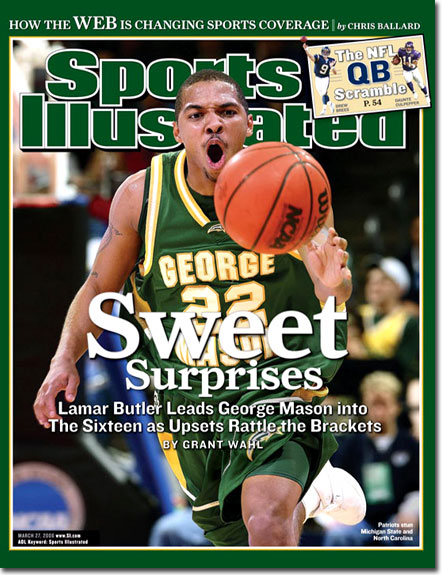
Unlike his neighbors, George Washington, Thomas Jefferson, and James Madison, founding father George Mason has rarely gotten his props from historians and the public. Until recently, the same could be said of the university bearing his name. But the advancement of Mason's basketball team to the NCAA's Final Four is only the school's latest surprise win. The GMU economics department—which didn't even award Ph.D.s until 1983—has two Nobel Prize winners on its faculty. The law school ascended to the first tier several years ago, a striking achievement for a new program that 10 years ago was being run out of an old department-store building. What's remarkable is that GMU's freewheeling basketball team and its free-market academic teams owe their successes to very similar, market-beating strategies.

GMU has excelled on the court and in the classroom by daring to be different. Its basketball team and academic programs began with the (correct) assumption that they couldn't hope to compete against the top schools in their fields—say, Harvard Law School or the Duke Blue Devils—by directly imitating their methods. GMU lacks the resources and reputation to recruit McDonald's All-Americans or Alan Dershowitzes. So instead, GMU has hunted for inefficiencies in its markets. Coach Jim Larranaga follows the Moneyball model of recruitment: hunting for the undervalued players—the ones who everyone else thought were too short, too thin, or too fat—and then building them into a team. In its astonishing defeat of UConn, GMU's players were giving away 4 inches at nearly every position.


This is also the idea behind GMU's free-market-oriented economics department. The department got started with a heretical premise: The academic market is inefficient, so how can we exploit it? GMU knew it couldn't afford to be a first-class MIT and didn't want to be a second-class MIT, so successive chairs of the department, backed by entrepreneurial university presidents George Johnson and Alan Merten, looked for unexploited opportunities.

James Buchanan, GMU's first Nobel Prize winner, has never had an Ivy League position and indeed he has never taught above the Mason-Dixon Line. Gordon Tullock, a potential future Nobelist, has no degree in economics and took only one class in the subject. Vernon Smith, who moved his team from the University of Arizona (again, no Harvard) to GMU in 2001, had to fight to get people to treat experimental economics as more than a cute parlor game.

From the 1960s into the 1980s, a small university such as GMU could hire conservative and free-market thinkers of true genius for the same kinds of reasons that, in the mid-1960s, a middling school like Texas Western University could recruit some of the best basketball players in the nation, so long as they were black, and win the 1966 NCAA championship. Conservative and free-market economists were so undervalued that GMU could afford the best of them.

GMU remains an underdog in both basketball and economics. But Coach Larranaga has a plan to succeed in the long term and so do GMU's professors. Click here to read about how GMU is seeking out different new kinds of undiscovered geniuses.

The odds are still against GMU on the court and in classrooms. Neither in basketball nor economics is GMU a top-10 school. We cannot match the endowment of a Harvard or Stanford. Building with the odds stacked against you is difficult, but GMU proves it can be done. Look for undervalued assets, eschew political correctness, and take the long view. But don't try to imitate Mason. The opportunities Coach Larranaga found will dry up. A small economics department today is more likely to succeed by assembling a quality group of socialists than free-marketeers. Bring it on! We're ready to play.

Slate also offers a great profile of many of the professors and programs in the GMU Economics department:

At GMU we practice Entrepeneurial Economics and we still think there are unexploited profits and oddball geniuses to be found. You can't get much stranger or more brilliant than Robin Hanson, one of the architects of the Defense Department's short-lived "terror futures market." Betting markets are now used to forecast elections and they are starting to gain a foothold in the corporate world. Hanson wants to go further and have policies decided by contests in betting markets. (He calls it "futarchy.") He also has contracted to have his head frozen upon his "death," and has good arguments for why this makes sense at market probabilities and prices.

Larry Iannaccone's field of expertise is religion. Larry asks, Is a free market in religion good for religion? Kevin McCabe and his co-authors have the first published paper about running brain scans on people while they make economic decisions. Neuroeconomics, as it is called, is now a major trend in the profession. How many economists are as comfortable talking about Michel Foucault, James Joyce, or Cuban artist Tomas Sanchez as they are about Milton Friedman? Tyler Cowen is, and in a series of books—the latest being Good and Plenty: The Creative Successes of American Arts Funding—Cowen has challenged economists to think about art and culture—and aesthetes to think about economics. Other economists at GMU are pushing the boundaries of development economics, studying the politics of rational irrationality, and redesigning electricity markets.

The outsider status of both the GMU economics department and the basketball team contributes to their styles of play. We like to have fun, which is one reason that GMU is well-known outside of academia. Marginal Revolution, Tyler Cowen and Alex Tabarrok's daily blog, is a widely read source of economic insights. Other faculty blogs include Café Hayek, The Austrian Economists, and EconLog. In old school media, Walter Williams is a nationally syndicated columnist and well-known radio personality and Russ Roberts is the author of an economic romance novel (really!).

See my own thoughts about why I love GMU’s PhD program here and here.

Visit our department’s webpage here.

PROUD TO BE A PATRIOT -- ON AND OFF THE COURT!!!


Hattip to Marginal Revolution.

Sunday, March 19, 2006

Getting Into GMU's Econ PhD Program?

GMU Professor Pete Boettke discusses "What Does It Take to Get Into GMU's Econ PhD Program?" (emphasis mine):
Economics is obviously a very competitive field and it doesn't get any easier after admission to a PhD program. The market for academic jobs in economics is also very competitive and requires those competing for these positions to really distinguish themselves.

Is it all worth it?

Personally, I can not think of a better way to make a living.
Read all of Pete's post. It's very good!

I definitely have to agree with Pete -- I can't think of a better way to make a living. This is only my first year in GMU's PhD program and I have to say, I have never been this happy about what I've been doing vocationally. I initially got interested in economics after having traveled to a number of developing countries and then reading a few books by Steven Landsburg and Milton Friedman. These books got me thinking about the conditions I had seen in these countries and how they were influenced by economic and political incentives. I quickly became convinced that economics offers the best explanation of anything I know for the disparity in the wealth of nations. Needless to say, this got me hooked. The more I read, the more I also became a firm believer in the virtues of liberty and the free-market as the best way of organizing productive human behavior.

Coming to GMU has been an amazing experience for me. I currently work at the Mercatus Center, researching economic development in Africa with Karol Boudreaux (who is currently in Rwanda). It has been great to get plugged in immediately into developmental economics, the issue that initially got me interested in economics.

I am also learning about both micro- and macro- economics and analytical tools for better understanding economic phenomenon. I have been able to attend seminars on diverse issues such as experimental economics, public choice, economic development, philosophy of economics, law and economics, economics of religion and more. In my 7 months here, I've met several Nobel Laureates, had long conversations with Gordon Tullock, learned about game theory, the Solow growth model and even had a chance to eat Chinese food with Tyler Cowen.

This has also been the most intellectually challenging experience of my life. It's been a little tougher than I thought to get my mind used to being back in school after having worked as an engineer for a number of years. Despite the challenges, I've never felt as excited about a topic I've studied or the direction I'm heading. Both my professors and my classmates are top-notch and I don't think I've ever been in an environment constantly surrounded by such interesting people before.

I love it here at GMU and can't think of anyplace I'd rather be!

Read more of my thoughts about why I love GMU here.

James Buchanan - Nobel Laureate

I attended a seminar with James Buchanan last week and was very impressed by GMU’s very own Nobel Laureate! I commented to Pete Boettke that I felt like I was listening to a legend. Boettke’s response was: “You are.” The more I reflect on what I heard that week, the more I agree.

Buchanan is one of the founders of the school of Public Choice, along with Gordon Tullock, another professor here at GMU with whom he co-authored the very influential book “Calculus of Consent”. Public Choice is the economic theory of politics, using the following 3 foundations in its analysis:

  1. Methodological individualism
  2. Homo economicus (rational self-interest)
  3. Politics as exchange
Here’s a few gems I got from the first day of Buchanan’s lectures:

    • “In the absence of individual interest, there is no interest.”
    • “Public debt and welfare cause utility loss to future generations and intergenerational transfers cause loss to one generation for the gain of another.”
    • "Public choice rejects the notion that the state is wiser than individuals.”
    On the second day of lectures, we watched a video of Buchanan interviewing one of my all time favorite economists, F.A. Hayek. They spoke about topics ranging from how decentralized government in the US has led to successful markets, ideas for separating taxation from legislation, positing that government should have no discretionary powers of coercion. In the video, Hayek claimed that “social justice” has no meaning. The more I have thought about this over the last few years, the more I think he’s right. (Read Thomas Sowell’s Quest for Cosmic Justice to learn more about this.)

    “Social Justice” sounds like a great idea, but has no objective basis to be measured against and presumes the knowledge and ability of people to be able to rearrange the world to establish justice for those who have been wronged in some way. The problem with this notion is that it is generally impossible to help one individual or group of people without harming another.

    During Buchanan’s discussion of Hayek, he mentioned how he had Hayek over to his house here in Fairfax before. I was amazed thinking about these two great minds meeting and spending time together not far from where I was. Very cool.

    Buchanan’s 87-year-old mind continues to be as sharp as a tack. He mad mention of individuals he’s come in contact with and/or researched ranging from Rawls to José Piñera (who I met last month), Hayek to the King of Sweden. Dr. Buchanan was definitely a treat to see.

    Some of Buchanan’s most interesting thoughts came when he described the gradual transition over the years of American society from being religious and looking to God for security and comfort towards looking at the state as a god. Buchanan’s thesis was that people look for psychological comfort and ordering of the world from a higher source. As society’s belief in God has waned, it has been replaced by a deep-held belief in the state. I spoke to Buchan afterwards about this and he said he felt that the church in the US has failed in teaching the moral norms for society. He was particularly critical of “mainline” denominations, but felt that evangelicals are starting to fulfill this role today. He also mentioned that he thinks one of the difficulties classical liberalism faces is that it does not offer the psychological comfort of an ordered and protected world.

    One of my favorite things Buchanan said was drawing an analogy between the American frontier and the free-market. He said that economists were failing to communicate the concept of the market in ways the public can easily understand and talked about how the market was like the frontier in the old American West. Like the frontier, a free-market allows you to enter and exit, an option not allowed by the state.

    Other questions and comments he offered included:

    • “Each man is his own economist.”
    • “Economists need to teach the basics again and again.”
    • “How would the US be different today if people coming off the boat were greeted with a welfare check instead of a shovel?”
    • “One of the roles of the church is to keep people from looking to government to be a god.”
    • “Do people want to be free?”
    • “The decline and the breakdown of the family has also led to a loss of security.”
    • To limit the power of government, we should have a generality norm in which any law or tariff has to be universally applied to all goods, people, etc. Examples of this include: imposing a tariff on one good means you have to impose an equal tariff on all other goods and a flat income tax. He said all “successful welfare states” (such as Sweden) apply a generality norm in some form or another. Most politics is caused by a conflict of interest and a generality norm would help alleviate this.
    Perhaps the most humorous thing he had to say was in quoting his old professor, Frank Knight:
    “I can’t figure out if people are bitching about the market because it works or because it doesn’t work.”
    I feel incredibly blessed to have had a chance to hear Buchanan lecture over the course of a week. He truly is one of the economic greats and a tremendous man with great ideas that have helped to change the world.

    Read more thoughts on Buchanan’s lectures last week by Frederic Sautet.

    Friday, February 17, 2006

    I Love George Mason!

    I went to dinner with GMU's experimental economics group after a presentation in Arlington tonight. I was delighted listening to Dan Houser and Bart Wilson discussing ideas with Sarah Brosnan on how to test ultimatum games with capuchin monkeys. Not only was the topic entertaining and humorous, but it was also intriguing and on the cutting-edge of economics research. It dawned on me as I was sitting there -- where else but at George Mason would I even overhear such a conversation?

    This got me reflecting on some of my experiences over this past week or so:

    These are only a few highlights of the past week that come to mind... And to think that on top of all of this, I'm also learning microeconomics, macroeconomics and econometrics and making progress towards a PhD!

    GMU is also home to some of the leading researchers in areas as diverse as experimental economics, public choice and economics of religion. Our faculty are superb and foster an incredibly collegial environment. Almost without exception, they are approachable, friendly and full of brilliant ideas. We have two Nobel Laureates on our faculty (James Buchanan and Vernon Smith) and another (Gordon Tullock) who has been nominated for the prize numerous times. GMU faculty are also the authors of some of the best economics blogs around including Marginal Revolution, Café Hayek and EconLog.

    GMU may not be ranked amongst the top econ programs (YET!), but I cannot think of anywhere else in the world that would give me access and exposure to the breadth of ideas, experiences and people that I have had here.

    Am I proud to be a Patriot? You better betcha!

    P.S. -- I think Walter Williams agrees.