
Monday, February 18, 2013


Sunday, February 17, 2013
Is America Becoming More Diverse?
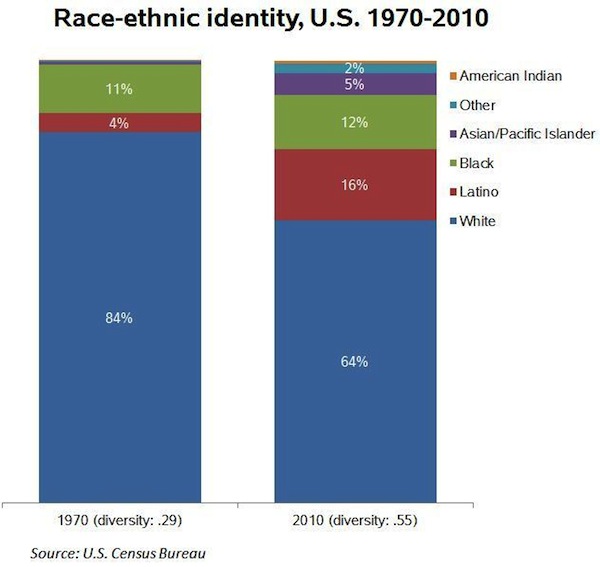
Philip Cohen takes a fascinating look at how America's population has changed since 1972 -- broken down by religion, race, marital status, and age of first marriage. Lots of changes and increasing diversity on all fronts.
There are various ways of constructing a diversity index, but I use the one sometimes called the Blau index, which is easy to calculate and has a nice interpretation: the probability that two randomly selected individuals are from different groups...Read the whole thing. Lots of interesting graphs.
I have complained before that using the 1950s or thereabouts as a benchmark is misleading because it was an unusual period, marked by high conformity, especially with regard to family matters. But it is still the case that since then diversity on a number of important measures has increased. Over the period of several generations, in important ways the people we randomly encounter are more likely to be different from ourselves (and each other).
Saturday, February 09, 2013
What to Expect When No One's Expecting
The title of a new book by Jonathan Last on the declining fertility rates in America and the negative impacts this will have on American society and economy. Here is Last writing in the Wall Street Journal:
The fertility rate is the number of children an average woman bears over the course of her life. The replacement rate is 2.1. If the average woman has more children than that, population grows. Fewer, and it contracts. Today, America's total fertility rate is 1.93, according to the latest figures from the Centers for Disease Control and Prevention; it hasn't been above the replacement rate in a sustained way since the early 1970s.
The nation's falling fertility rate underlies many of our most difficult problems. Once a country's fertility rate falls consistently below replacement, its age profile begins to shift. You get more old people than young people. And eventually, as the bloated cohort of old people dies off, population begins to contract. This dual problem—a population that is disproportionately old and shrinking overall—has enormous economic, political and cultural consequences...
Low-fertility societies don't innovate because their incentives for consumption tilt overwhelmingly toward health care. They don't invest aggressively because, with the average age skewing higher, capital shifts to preserving and extending life and then begins drawing down. They cannot sustain social-security programs because they don't have enough workers to pay for the retirees. They cannot project power because they lack the money to pay for defense and the military-age manpower to serve in their armed forces.Read the whole thing.
(HT Tyler Cowen)
Wednesday, November 28, 2012
I Am Now Officially Dr. Hollar!

I successfully defended my dissertation earlier today and am now officially Dr. Hollar! It has a been a long road getting here, but a journey I am very happy to have both started and finished.
The image above is the introductory slide for my defense presentation. I decided to have a little fun with it.
I am profoundly grateful to my dissertation committee, to GMU, and to all my family and friends who supported me these past few years. And a special word of thanks to Marymount University who not only provided me with a faculty position prior to graduation, but also gave me the time and support to successfully finish my PhD. I continue to feel like I landed a dream job in a dream location.
Next stop, tenure!
Monday, November 26, 2012
Tyler Cowen's Favorite Non-Ficton Books of 2012

- Laurent Dubois, Haiti: The Aftershocks of History.
- Charles Murray, Coming Apart: The State of White America, 1960-2010.
- David Hackett Fischer, Fairness and Freedom: A History of Two Open Societies: New Zealand and the United States.
- George Dyson, Turing’s Cathedral: The Origins of the Digital Universe.
- Jon Gertner, The Idea Factory: Bell Labs and the Great Age of American Innovation.
- Michael Dirda, On Conan Doyle: Or, The Whole Art of Storytelling.
- James Fallows, China Airborne.
- Greg Woolf, Rome: An Empire’s Story.
- Odd Arne Westad, Restless Empire: China and the World Since 1750.
- Robert D. Kaplan, The Revenge of Geography.
- Barry Eichengreen, Dwight H. Perkins, and Khanho Shin, From Miracle to Maturity: The Growth of the Korean Economy.
My additions to the list would include James Manzi’s Uncontrolled, Enrico Moretti’s The New Geography of Jobs (in my opinion, one cannot put Murray on the list and leave out Moretti), Bruce Schneier’s Liars and Outliers (that one does not seem to have impressed anyone else I know), Paul Reid’s completion of William Manchester’s three-volume biography of Winston Churchill, and Jonathan Haidt’s The Righteous Mind (this is on an even higher plane, in my opinion–a candidate for book of the decade? See my review essay.)I'm afraid I've been too busy working on my dissertation this past year to have much to add. Hope to remedy that next year. In the meantime, I just added Murray's Coming Apart and Haidt's The Righteous Mind to my reading list.
Wednesday, November 07, 2012
Everything You Need to Know About the Fiscal Cliff
The Wall Street Journal:
Last August, President Obama and Congress put the U.S. economy on course to go over a "fiscal cliff." WSJ's David Wessel tells you everything you need to know about the "cliff" but were afraid to ask.(HT Greg Mankiw)
How Did the Prediction Markets Do?
Below is a map showing the results of yesterday's elections.

And here is the map of prediction market forecasts I posted on October 1st.

Florida has yet to be called, but if it goes to Obama, then the prediction markets will have accurately forecasted 50 out of 50 states five weeks before the election.
Here is how the prediction markets fared in 2004 and 2008. I'd say they nailed it yet again!
Read more of my posts on prediction markets here.
And here is the map of prediction market forecasts I posted on October 1st.
Florida has yet to be called, but if it goes to Obama, then the prediction markets will have accurately forecasted 50 out of 50 states five weeks before the election.
Here is how the prediction markets fared in 2004 and 2008. I'd say they nailed it yet again!
Read more of my posts on prediction markets here.
Monday, November 05, 2012
One Last Look At Prediction Markets Before Tomorrow's Election

This is the latest prediction for tomorrow's election on Intrade. These predictions have been remarkably stable since October 1st, with only Florida changing from being likely to vote Democratic to now likely to vote Republican. Virginia and Colorado have shifted back and forth a bit over the past few weeks, but both are still predicted to go Democratic.
It will be interesting to see the final tally tomorrow night and compare it to Intrade's forecast over a month ago. If this map matches the final outcomes tomorrow, Intrade will have accurately predicted 49 out of the 50 states one month before the election.
Stay tuned!
How Powerful Is Your Vote?
When it comes to voting, not all states are created equal.
Garett Jones explains why he loves the electoral college. (For the record, I do too.)
David Henderson explains why it will never go away.
Garett Jones explains why he loves the electoral college. (For the record, I do too.)
David Henderson explains why it will never go away.
A Campaign Map, Morphed by Money
A very cool animated infographic by NPR on how the US would look if states were resized according to campaign spending. Follow the link for more info.
Subscribe to:
Posts (Atom)