Monday, July 06, 2009

The Holy Grail of Ultralight Travel?

I just returned from a month in Santa Fe, traveling with nothing but what could fit into my carry-on luggage. I still feel like I brought too much. Here is a good article on how to travel for six-weeks with only 15 pounds of luggage:
Is it possible to travel for six weeks with 7 kilograms of luggage in one small bag? I’m a person who takes a bootload of gear for a weekend away but on a recent 40-day trip to nine European countries I achieved the light traveller’s Holy Grail.

It took lots of planning but it was worth it. I was smugly self-congratulatory as my bag measuring 45cm x 30cm x 18cm and I fitted unobtrusively into crowded trains and buses; as I effortlessly tossed it onto luggage racks; as I bypassed taxi queues to stride easily through city streets; as I unpacked and repacked in five minutes flat. Not once did I wish I had brought more stuff…

Travelling light makes you feel independent, liberated and, well, superior. But it takes a stern approach and a willingness to accept strict limitations in your attire. Here are 10 steps to success.
Read the whole thing, including a recommended packing list.

While I can claim to have mastered the art of traveling small (I made it to all 7 continents without checking a bag), I am still working on the art of traveling light. The three things things that killed my weight on this last trip were: 1) bringing two textbooks, 2) two laptops (one of them being my netbook), and 3) my DSLR camera. If I had to do it over again, I would have left one (or both) of the textbooks and my netbook at home. (I was in Santa Fe for summer school studying complex systems at the Santa Fe Institute and needed more computing power than my netbook could provide.) On this trip, however, my dSLR was worth its weight in gold through a combination of quick-shooting, great picture quality, and incredible battery life. I'd be hard pressed to leave it at home for future excursions. (I'd love to get my hands on a Canon G10 at some point and see how well it would work as a dSLR substitute.)

(HT One Bag, One World)

Friday, July 03, 2009

Rafting Down the Rio Grande

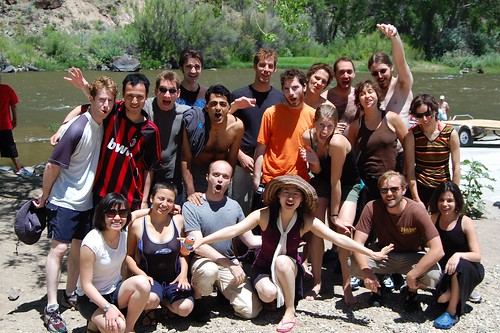
A photo of our group after two hours of whitewater rafting down the Rio Grande River. See more of my photos here or watch them as a slide show.

DSC_9299
(click image for larger size)

You can see photos of me in action in the raft (in the middle on the right) here, here, here, here, here, here, and here.

I'm very sad to be leaving Santa Fe tomorrow. The past month has been such a fantastic experience intellectually, socially, and experientially -- I hate to see it end. It will be tough saying good-bye to everyone tonight.

How the Market Influences What Language You Read In

Daniel Hamermesh:

My Dutch friends tell me that they read foreign (non-Dutch) novels that are translated into English rather than into Dutch.

Their English is very good, but their Dutch is clearly better. So, I ask, why read in English?

Their answer is simple: take a book originally in Swedish, like Stieg Larsson’s wonderful Girl With the Dragon Tattoo. If somebody translates it into Dutch, the relatively small number of Dutch-speakers means that the market for the translation will be much smaller — and the royalties and profits smaller too — than the market for an English translation.

These smaller returns attract translators who are not as good as those attracted into translating a book into English; the supply curve of translators is upward-sloping.

My friends say they would rather read a good translation into a language they know well, but not perfectly, than a mediocre translation into their native language.

Thursday, July 02, 2009

Rodeo Photos

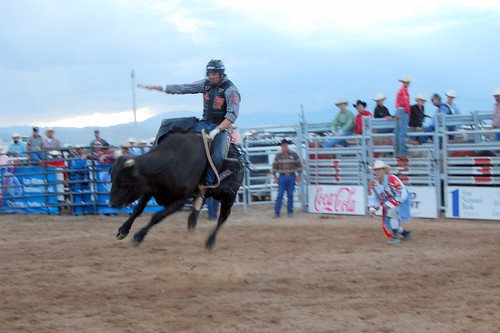
Here are some more pictures I took at the Santa Fe Rodeo last week. See many more here or watch them all as a slideshow.

DSC_8976

DSC_9090

DSC_8317

DSC_8631

It Takes A Free Market To Build A Toaster

Freakonomics:
It takes a lot of people to manufacture even the simplest products, so making a household appliance on your own shouldn’t be expected to be easy. It may even be impossible. That’s what the artist Thomas Thwaites is finding as he tries to make a toaster from scratch, traveling around the world to collect raw materials and refining his own petroleum for plastic moldings. Aware that he still won’t be able to accomplish his task without the help of modern appliances, like a microwave, Thwaites claims his experiment points to the “helplessness” of the modern consumer. At Reason Online, meanwhile, Radley Balko argues that our inability to make a toaster doesn’t mean we’re helpless at all, but rather that we’ve been liberated by free markets. (This is hardly a new argument; consider the pencil, and similar tales.)
People who argue modern consumers are helpless typically argue we ought to live in a world of some form of individual autarky, where we are able to make/grow/produce everything on our own. This completely misses the insight of gains from trade and the associated benefits of division of labor, specialization, etc.. Without understanding that they are doing so, what they are actually arguing for is that we all live in poverty.

Nothing is stopping people from living a more simple lifestyle of self-production in the US. The fact that very few people chose to do so ought to tell you something.

The Big Five Personality Test


Here's how I scored:


Your Results

Closed-MindedOpen to New Experiences
DisorganizedConscientious
IntrovertedExtraverted
DisagreeableAgreeable
Calm / RelaxedNervous / High-Strung

Openness to Experience/Intellect

High scorers tend to be original, creative, curious, complex; Low scorers tend to be conventional, down to earth, narrow interests, uncreative.

You enjoy having novel experiences and seeing things in new ways. (Your percentile: 80)

Conscientiousness

High scorers tend to be reliable, well-organized, self-disciplined, careful; Low scorers tend to be disorganized, undependable, negligent.

You are neither organized or disorganized. (Your percentile: 58)

Extraversion

High scorers tend to be sociable, friendly, fun loving, talkative; Low scorers tend to be introverted, reserved, inhibited, quiet.

You are extremely outgoing, social, and energetic. (Your percentile: 93)

Agreeableness

High scorers tend to be good natured, sympathetic, forgiving, courteous; Low scorers tend to be critical, rude, harsh, callous.

You are good-natured, courteous, and supportive. (Your percentile: 94)

Neuroticism

High scorers tend to be nervous, high-strung, insecure, worrying; Low scorers tend to be calm, relaxed, secure, hardy.

You probably remain calm, even in tense situations. (Your percentile: 7)
Read more about the test here or try taking it yourself.