Nearly 55,000 Haitians have been approved for family visas but are on waiting lists to enter because Congress has set limits on how many may come each year, the State Department says…
Elliott Abrams, a deputy national security adviser under President George W. Bush who is now at the Council on Foreign Relations, said that if the United States doubled for the next five years the 25,000 Haitians who have been coming to the United States annually, it would substantially increase the remittances sent back, providing critical help as the nation tries to rebuild. Such help streaming home to families is more reliable and more likely to be spent efficiently than the ebb and flow of foreign aid, he said. Abrams suggested that to satisfy critics of increased immigration, the United States could offset the influx of Haitians by temporarily slowing immigration from elsewhere.
A photo of me and a young boy I used to sponsor in Haiti. (He’s now a teenager.) He and his mother moved years ago and the agency I was sponsoring him through lost touch with him. I have no idea if he is alive or safe right now.
Maybe you thought Obama was the "health care President" or perhaps the "Afghanistan President", but to my eyes right now he looks like the "Haiti President." I predict we'll have over a million Haitians living in refugee camps for the foreseeable future. (It depends how many of the homeless of those can be absorbed by northern Haiti.) If people don't make it into camps they will be sleeping on the street with little or no means of food or water or employment.
It's a mistake to think there's any brick-by-brick way out of that predicament. It's not like the earthquake in Armenia or for that matter eighteenth century Lisbon. Haiti has no functioning government, no working legal system, and very little remaining infrastructure. There's no formal means to make decisions about reconstruction and no capital to clear away the mess. As I've written, the country as we know simply doesn't exist any more (view the second video or try these photos). Port-Au-Prince is destroyed and the city was the heart of the country, economically, politically, and otherwise. Léogâne, Jacmel, and other significant locales are mostly destroyed as well and they're not receiving much assistance.
Obama will (and should) do something about this situation. First, I believe he sincerely wants to help but also he cannot ignore his African-American constituency, especially after former President Clinton devoted so much attention to Haiti and especially if health care reform doesn't go through as planned. Yet he will have a festering situation on his hands for the rest of his term. If "looting" (a bad word in this context) increases or continues, how quickly will the American people lose sympathy with the Haitians? How can the "reconstruction" possibly go well? Ugly gang rule isn't even the worst case scenario.
When the immediate crisis passes, how can we ensure that Haiti becomes a functioning nation? Eight experts give their prescriptions.
Concrete Solutions By JOHN McASLAN An internationally financed rebuilding effort should take a longer view of Haiti’s future, supporting a gradual, well-thought-out physical transformation.
Squatters’ Rights By ROBERT NEUWIRTH With hundreds of thousands of Haitians turned into refugees in their own hometown, a few sensible squatter principles may help the devastated residents.
Skip the Graft By JAMES DOBBINS Haiti’s institutions need to be rebuilt as well as its buildings, with fundamental reform of inefficient and corrupt systems.
Learn From Postwar Tokyo By MATIAS ECHANOVE and RAHUL SRIVASTAVA As we consider how to rebuild Port-au-Prince, we can find an alternative to the usual top-down redevelopment model in postwar Tokyo.
A Recovery Built on Water By STEVEN SOLOMON In rebuilding Haiti’s water systems, it is imperative to focus on simple and affordable local projects that communities can take responsibility for.
Easy Money By DAN SENOR A discretionary fund that American military officers can dip into for development projects and crisis responses should be expanded to Haiti.
Guantánamo to the Rescue By JONATHAN M. HANSEN Just 200 miles from Port-au-Prince, the United States naval base at Guantánamo Bay should be used as the base for humanitarian intervention.
Keep the Economy Underground By SUDHIR VENKATESH Countries aiding Haiti must be careful not to drum out the positives of informal development.
Don’t donate goods. Donating stuff instead of money is a serious problem in emergency relief. Only the people on the ground know what’s actually necessary; those of us in the rest of the world can only guess. Some things, like summer clothes and expired medicines are going to be worthless in Haiti. Other stuff, like warm clothes and bottled water may be helpful to some people in some specific ways. Separating the useful from the useless takes manpower that can be doing more important work. It’s far better to give money so that organizations can buy the things they know they need…
Don’t go to Haiti. It’s close to the US, it’s a disaster area, and we all want to help. However, it’s dangerous right now and they don’t need “extra hands”. The people who are currently useful are people with training in medicine and emergency response. If all you can contribute is unskilled labor, stay home. There is no shortage of unskilled labor in Haiti, and Haitians will be a lot more committed than you are to the rebuilding process.
If you are a nurse or physician, especially with experience in trauma, and you want to volunteer, email Partners in Health – volunteer@pih.org – and offer your services. Or submit your details to International Medical Corps. They’ll take you if they can use you. Do not go to Haiti on your own, even if you are doctor. You’ll just add to the confusion, and you’ll be a burden to whoever ends up taking responsibility for your safety.
Don’t ignore rebuilding. The physical damage done to Port au Prince is going to take a long, long time to repair. The human consequences will have a similar slow recovery. Haiti will still need our help next year, and the years after that. It is going to take more than just a short-term infusion of relief money. Give your money to organizations that will be in Haiti for the long haul, and don’t forget about Haiti once the media attention moves on.
Where the major damage occurred. Leogane is the area I visited many years ago and, while not in the epicenter, has been affected by the quake. More charts and graphics of the damage here.
This is not a natural disaster story. This is a poverty story. It’s a story about poorly constructed buildings, bad infrastructure and terrible public services.
….
Over the past few decades, the world has spent trillions of dollars to generate growth in the developing world. The countries that have not received much aid, like China, have seen tremendous growth and tremendous poverty reductions. The countries that have received aid, like Haiti, have not.
In the recent anthology “What Works in Development?,” a group of economists try to sort out what we’ve learned. The picture is grim. There are no policy levers that consistently correlate to increased growth. There is nearly zero correlation between how a developing economy does one decade and how it does the next. There is no consistently proven way to reduce corruption. Even improving governing institutions doesn’t seem to produce the expected results.
The chastened tone of these essays is captured by the economist Abhijit Banerjee: “It is not clear to us that the best way to get growth is to do growth policy of any form. Perhaps making growth happen is ultimately beyond our control.”
Also of interest in the article is Brooks’ argument that Haiti’s “progress-resistant” culture is largely to blame for the country’s extreme poverty. This strikes me as overly reductionist (although interesting recent economicsresearch does point to the importance of values like trust in determining prosperity.) Brooks’ list of rejected explanations include slavery and colonial history, bad government and corruption, foreign invasions, geography and climate. I wonder what others who have spent time studying, living or working in Haiti think of the relative weight of these explanatory variables.
...contact the White House and tell them that you support granting Haitians Temporary Protected Status (TPS) immediately.
TPS is a form of temporary humanitarian immigration relief given to nationals of countries that have suffered severe disasters, natural or man-made. (For example, El Salvador got TPS was after the country was hit by a terrible earthquake in 2001, Honduras after Hurricane Mitch in 1999, and Burundi, Liberia, Sudan, and Somalia were designated because of ongoing armed conflicts.)
Once a country has been given TPS, its nationals who are in the United States can apply for work authorization (a very useful thing to have if, say, one needs to send money home to family members in need of medical care or a house that has not been reduced to rubble), can't be deported or put into immigration detention (also quite handy if you're trying to work and send money home), and can apply for travel authorization, which allows them to visit their home country and return to the US, even if they wouldn't otherwise have a visa that would allow them back into the country (incredibly important if you have loved ones who have been badly hurt and need to visit them, or if you need to go home to attend funerals).
Designating Haiti for TPS status would provide an immediate, tremendously valuable benefit to Haitian immigrants in the United States. But, more importantly it would benefit their loved ones who remain in Haiti and are in desperate need of their assistance.
…in the short term, the initial reports make it seem like we're going to have to impose some sort of order just to distribute aid. At this point, we can assume that people are already dying from lack of medical care, clean water, and relief supplies, and the losses will mount geometrically as days pass. But there is no one to tell anyone what to do, and no way to tell them, as all communications seem to be knocked out. Until they're restored, Haiti is effectively in the eighteenth century.
But in the longer run, what do you do for a country that already had one of the worst-functioning governments in the world? Half the budget was provided by foreign aid before the earthquake. For the next few years, we will effectively hold government power there, whether we want to or not, because we'll probably essentially be providing all of its funding, and can threaten to turn the taps off unless things go as we demand.
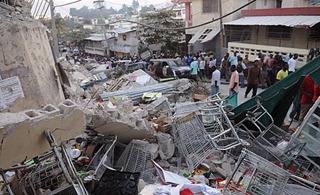
Haiti is about the size of Maryland and a big chunk of the population lives in or near Port-Au-Prince, maybe a third of the total, depending on what you count as a suburb. So the collapse of Port-Au-Prince is a big, big deal for the country as a whole. It's a dominant city for Haiti. Plus Jacmel seems to be leveled. From the reports I have seen, my tentative conclusion is that the country as a whole is currently below the subsistence level and will remain so for the foreseeable future. Hundreds of thousands of people have died, the U.N. Mission has collapsed, the government is not working (was it ever?), and hundreds of thousands or maybe millions of people are living in the streets without reliable food or water supplies. The hospitals and schools have collapsed. The airport is shut down. The port is very badly damaged. The Haitian Penitentiary has collapsed and the inmates -- tough guys most of them -- are running free for the foreseeable future. There is no viable police force or army.
In other words, it's not just a matter of offering extra food aid for two or three years.
Very rapidly, President Obama needs to come to terms with the idea that the country of Haiti, as we knew it, probably does not exist any more.
(T)he Haitian earthquake killed tens of thousands of people. But the quake that hit California's Bay Area in 1989 was also of magnitude 7.0. It killed only 63 people. This difference is due chiefly to Americans' greater wealth. With one of the freest economies in the world, Americans build stronger homes and buildings, and have better health-care and better search and rescue equipment. In contrast, burdened by one of the world's least-free economies, Haitians cannot afford to build sturdy structures. Nor can they afford the health-care and emergency equipment that we take for granted here in the U.S.
These stark facts should be a lesson for those who insist that human habitats are made more dangerous, and human lives put in greater peril, by freedom of commerce and industry.
Economic freedom saves lives. The ultimate tragedy in Haiti was not the earthquake. It was Haiti’s lack of economic freedom. That tragedy plays out every day in most of the third world.
Even before Tuesday’s devastating earthquake, Haiti had a distressed economy.
It is one of the poorest countries in the Western hemisphere, with around 80 percent of the population living under the poverty line and 54 percent living in abject poverty, according to the CIA World Factbook. More than two-thirds of the labor force are believed to not have formal jobs, and just 62.1 percent of adults over age 15 are literate, according to the United Nations Human Development Report.
Despite the destruction wreaked by multiple tropical storms in 2008, in many ways Haiti’s economy and infrastructure-building seemed to be turning a corner in recent years, aided by international support and debt relief programs.
In fact, Haiti was one of only two Caribbean countries expected to grow in 2009. There were hopes of a tourism revival, reinforced by the announcement that a new Comfort Inn would open there this May. In a sign of its growing structural sophistication, Haiti even recently announced that it would begin collecting better national statistics, with the help of the International Monetary Fund, so that it could better assess and calibrate its economic policies.
But, as Mark Leon Goldberg writes in The Daily Beast, “This is Haiti’s tragedy: Just as the trend lines shift in the right direction, calamity strikes.”
For more information on Haiti’s economic development and challenges, go here, here, here, here and here.
Update: Here are some theories from Tyler Cowen about why Haiti has remained so poor.
Early [yesterday] evening, a massive earthquake rocked Haiti, the United States' island neighbor to the south and, by far, the poorest country in the Western hemisphere. The earthquake measured a 7.0 on the Richter scale and occurred close to the densely populated capital of Port-au-Prince. Initial reports indicate massive building damage, including to hospitals and water and electricity plants. Casualties are expected to number in the thousands. The United States and other nations have started to deploy emergency aid; U.N. envoys Paul Farmer and former president Bill Clinton are rallying aid as well.
Update: Mark Goldberg at U.N. Dispatch flags a worrying story. The earthquake has reportedly destroyed the U.N. peacekeeping mission's headquarters in Haiti; the U.N. keeps around 7000 troops in the country. Mark worries about the U.N. peacekeepers' capacity to act as first responders. The quake has also destroyed at least part of the country's presidential palace.
Also: the L.A. Times has a good list of Twitter users to follow in Haiti. Electricity, landline, and cell phone service appears to be out in much of the country.
More on this here and here. Wikipedia has a page up with more details on the earthquake. Reuters has ongoing coverage. Here are Twitter updates from people in affected regions.
Haiti was the first developing country I ever visited and ties with rural India for the poorest living conditions I have ever seen. With many poorly constructed buildings throughout the country, poor infrastructure, and a lack of emergency response services -- I cannot imagine how bad things must be in Haiti right now.
Thankfully, no one I know was hurt, but the compound I stayed in (10 miles from the epicenter) had five buildings destroyed by the quake. Here is a video from Tim De Tellis, one of the guys I traveled with while there, with a message from Haiti:
The tragedy seems to be of proportions unimaginable to people living in a rich society replete with earthquake codes. Please give something if you can spare it.


 Tyler Cowen:
 Alanna Shaikh:


 Wow:
Wow: John Stossel:
 Catherine Rampell:
 Terrible: